{draft}
{2014 edit}
I am starting to separate the non 70cm specific areas of this document. They will be moved to:
http://www.qsl.net/kb9mwr/wapr/tcpip/amprnet.html
How Rules Change
First, here is a recent example of how the rules change as we do, from March
2011:
http://www.arrl.org/news/arrl-files-em-petition-em-em-request-for-temporary-waiver-em-with-fcc-regarding-vhf-voice-and-data-e
http://www.arrl.org/news/fcc-seeking-comments-on-arrl-petition-regarding-tdma
http://www.arrl.org/news/fcc-seeks-to-change-amateur-radio-licensing-rules-allow-additional-emission-types
The petition asks the FCC to allow those amateurs who are presently using a Motorola
narrowband (12.5 kHz) digital land mobile system -- commercially marketed as
MotoTRBO
-- to be used legally. Because of some restrictions in the Part 97 rules, the
TDMA repeaters (which are multiple-time-slot devices) are legal, but the mobiles
and portables are not because the emissions used ….
The KA9FLX repeater in Chicago, IL was the first Mototrbo Amateur Radio Repeater. It
was put on the air in 2008. At the time of this petition, there are more that a
dozen Mototro repeaters in service on amateur frequencies. Since then,
over 90 repeaters have been reported as up and running.
It appears that some overly concerned fellow Amateurs on the radioreference forums
brought the this emission rule technicality to the forefront.
In early 2011 the issue was raised as to the legality of DMR/MOTOTRBO for use under FCC Part 97 . Motorola had classified MOTOTRBO as emission types 7K60FXD (data only mode) and 7K60FXE (data and voice mode) . A careful reading of Part 97.305 led many to conclude that these emission types are not allowed in the Amateur Radio Service
The ARRL petitioned the FCC to revise the rules to clarify the situation and allow DMR on the ham bands . In March 2011, the FCC opened RM-11625 and asked for public comments. While over a year later the FCC has not taken action . Motorola filed with the FCC to add new emissions designators to the MOTOTRBO equipment. The modes of interest to amateur radio are 7K60F7W for the repeater stations and 7K60FIW for the user radios. These emission types are specifically allowed in Part 97 .
Since there have been no public enforcement actions on the part of the FCC, we have to conclude that they don' t see a problem.
June 9th, 2014 the FCC officially approved the use of TDMA, the modulation type used by Digital Mobile Radio (DMR), for ham radio use.
Open source advocate, Bruce Perens, K6BP who has been promoting the Codec 2 project, filed comments in December 2012, in reply to the TDMA debacle.
To quote from his filing:
In a subsequent
filing, Bruce furthers; "Rules Incorporating Modulation Designator Letters Which Specify the Payload or Mode are Obsolete".
And "Digital Communication Breaks FCC’s Amateur Band-Planning.."
I am more concerned by underutilized spectrum, and red flags that people throw
that deter experimentation in the hobby.
Note: The ARRL membership is fairly conservative. The last time they proposed regulation by bandwidth (2005), their membership made them withdraw the request for rule-making.
--
FCC Personal Radio Service Revisions Will Affect GMRS, FRS, CB, Other Part 95 Devices (WT Docket No. 10-119)
April 2017
FCC Technological Advisory Council Investigating Technical Regulations (FCC Docket 17-215)
August 2017
This is a good point, however it's an ideal situation, where everyone is an
experimenter and less of an appliance operator. The idea in pushing for
rules changes in relation to data without a pressing usage case is; future commercial/import
products might be able to be adapted to ham use, like we have done with 802.11
for the microwave bands. And secondly in the rare case of that talented
experimenter/designer I'd like the rules already in his favor so he doesn't get
a bunch of flack from the community for any grey area rules (we are horrible
with this). Remember STAs are only good for 6 months, which seems to pose
a bit of a bureaucratic processes. Never-never
poo-poo those who are doing something!
Before the advent of digital transmission modes, several analog schemes were
developed to transmit images or image-like information on the Amateur Radio
bands.
Postwar
Amateur Television At the September 2012 DCC in Atlanta, GA, David
Bern, W2LNX presented a paper titled "Experimenting
with High Speed Wireless Networking in the 420 MHz Band."
His paper reports on testing two different manufactures of
802.11 mini-PCI cards capable of operation in the 70 cm ATV sub-band using 5 MHz
bandwith. Test applications were a Webcam video
We urge FCC instead to apply a framework that recognizes the reality of
communication today: one based solely on emitted bandwidth, rather than
increasingly-blurry, and unnecessarily restrictive, definitions of emission
“type.”
That
said I have a few extra picture frames and would be fine framing my first
"pink slip" over silly outdated rules in the name of experimentation.
As long as your “intent” is pure in amateur spirit, in my eyes this is
the only major regulatory requirement you should concern yourself with
initially.
I
firmly believe that the rules will change as we do. The Part 97 Amateur Radio
Service rules should not be inflexible with respect to the encouragement of new
digital technologies which improve spectrum efficiency.
"Wouldn’t the petition make a little more sense if we were already maxed out on the current rules?
When you look at what’s possible today with modulation modes like 8-PSK and 16-QAM, using LDPC or other modern error correction methods, it seems to me we should be focusing on that first and
getting people to actually use what’s there already."
70 cm ATV History
In
March 1949 Bob Melvin, W6VSV conducted possibly the first Amateur Television
transmission in the San Fransiciso Bay area on 423 MHz.
In
January 1974, the first 70 cm Amateur Television repeater, WR4AAG was allowed in
the Washington DC area, by way of a FCC- STA to wave section 97.61(c). In March
1976, the FCC issued a public notice to waive section 97.61(c) for the period of
one year to permit fast-scan ATV stations outside of the repeater sub-bands.
It
appears that fast-scan ATV has been formally permitted on 70 cm since February
1959. (1)
The
repaid development and expansion of color TV receivers freed up lots of older
black and white sets in the back rooms of TV service shops across the country
and helped fuel the first boom in Amateur Television (ATV) activity on the part
of Amateur Radio operators. Though the 1960s, most operation was done using
monochrome equipment. Operation was confined to UHF frequencies and above
(beginning what what is now the 420-450 MHz, 70 cm band), which meant that
virtually all activity was local in nature and severely impacted by adverse
terrain. (2)
While
the short-term outlook for conventional ATV is bright, the long-term situation
is quite different. Put bluntly, ATV operations based on NTSC (or PAL) broadcast
standards have no real viability much past the end of the current decade! This
may seem like a harsh assessment, but it is really a call to look seriously at
what trends are viable in terms of future development and growth. Let’s start
with the basis for the assessment itself and then look at where we should be
going. The assessment is based on two issues:
-
Equipment availability
-
Spectrum management
(3)
Future
Directions
Given
the technological changes in broadcast television, there are only three possible
trajectories for future development and they are far from being equal;
1.
Do nothing and stay with the NTSC standard.
2.
Adopt a broadcast DTV standard.
3.
Develop Amateur Digital Standards.
Amateur
radio is a communications, not an entertainment service. Given the changes
sweeping the TV broadcast industry, this may well be an opportune time to break
from broadcast standards with respect to ATV and craft a television option
better suited to the needs and objectives of the Amateur Radio service. Properly
conceived, such an effort can eliminate dependence on expensive DTV equipment,
address the issue of responsible spectrum usage, and bring ATV closer to the
amateur mainstream in terms of equipment requirements. If
we suspend parochial perspectives and make the assumption that a full-motion
television standard has a place in Amateur Radio, it is clear that the third
option listed above has a great deal of potential. (4)
The
subject of Digital Amateur Television made Stan, WA1LOU’s ARRL Surfin’
column a couple times in 2008. As well as CQ-VHF magazine in 2004.
Despite
this, there is still a surprisingly small amount of current D-ATV activities in
the United States. (5) Most DATV is in Europe,
despite high costs.
It
has been said that Image communications were never intended to be a mode
independent of phone.
With
that said, I tend to agree with option three above.
The test documented in his paper prove a sustainable data rate of 1 Mbit/s over 10 miles.
97.307(f)(6) States; “A RTTY, data or multiplexed emission using a specified digital code listed in 97.309(a) of this Part may be transmitted. The symbol rate must not exceed 56 kilobauds. A RTTY, data multiplexed emission using an unspecified digital code under the limitations listed in 97.309(b) of this Part may also be transmitted. The authorized bandwidth is 100 Khz.”
Section 97.307(f) of the FCC Rules limits the digital data emissions of amateur stations operating to maximum symbol rates. In a digital system the symbol rate is the number of times per second that a change of state occurs. It should not be confused with data rate (also called bit rate) although in a binary system the values will be the same. The symbol rate limits date back to the Third Report and Order in FCC Docket 20777 and became effective on March 17, 1980, when amateurs in the United States were authorized to use ASCII.
Please note that with Spread Spectrum modulation like OFDM, these limits if even applicable would pertain to individual carriers not the cumulative sum. See: http://www.arrl.org/arrlletter?issue=2007-04-27
"In fact, 3 kHz bandwidth would have been a new limitation, because the present baud rate limit applies to individual carriers," he said. "Therefore, for emissions such as OFDM [orthogonal frequency-division multiplexing], which use multiple carriers, there is no effective bandwidth limit in the HF bands now." Sumner notes that under current rules, a single OFDM signal could conceivably -- and legally -- occupy an entire HF band." (much like image emissions)
It appears that the 56 kilobaud speed / 100 Khz bandwidth data rule for 70cm came into existence in the early 1980's when the FCC revised the rules to allow experimental digital codes and adopted ASCII as a standard. (6)
DVB-S used by some amateurs for Digital ATV has a signaling data rate that well exceeds this antiquated rule. But that is classified as an image emission, which is exempted from the data emission rules. Spread spectrum emissions are also exempted from the data emission rule. While 802.11b uses direct sequence spread spectrum (exempt from the data rule), 802.11g uses OFDM, which is not classified as spread spectrum.
ATV
Repeater Tally
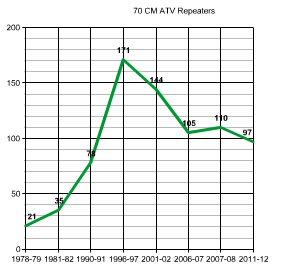
ATV activity on the 70 cm band hasn't exactly been growing. The following
is graph of 70 cm ATV Repeaters (inputs, outputs or both on 70cm). Data
was taken from ARRL Repeater Directories for the years show. It's hard to
justify, of 20 MHz of space for exclusively for this mode. I feel the
gates should be opened to allow other possible co-existable wider band uses.
John
Stevensen, KD6OZH* in 2005 began development of a HSMM Orthogonal Frequency
Division Multiplexing (OFDM) Modem that will allow Radio Amateurs to have all
–mode voice, text, data, and video (i.e., multimedia) high-speed digital
communications on the VHF, UHF and SHF bands. Alpha testing of the OFDM modem
was done in Texas using an ATV channel in the 70cm band operating in a digital
“image mode” coined Amateur Digital Video (ADV). He originally stared with some experiments with a STA on 6
meters. He moved to 70 cm calling it ADV (Amateur Digital Video), to get around the 100 KHz 56 kilobaud speed speed rule for 70cm he added the image component to his project, so that is could be classified as image transmission instead of
data.
In
a January 2005 report to the ARRL board of directors, the HSMM Technology Task
Force submitted the following concept as basis for such a 70 cm OFDM modem
capable of Amateur Digital Video.
The
70 cm band is ideal for HSMM and, using the following interpretation of FCC
regulations, we should be able to use OFDM modems with an occupied bandwidth up
to 9 MHz (at least) on the 70 cm band. HSMM would be classified as an image
emission type. This interpretation also allows 6 kHz (or more) bandwidth OFDM
modems on the MF and HF amateur bands.
In
47 CFR 97.315 the emission type "image" is defined as including
"emissions having B as the first symbol; 7, 8 or 9 as the second symbol; W
as the third symbol".
In
47 CFR 2.201 (c) (2) a first symbol of B defines the type of modulation of the
main carrier as an "emission in which the main carrier is
amplitude-modulated (including cases where sub-carriers are angle-modulated)
with independent sidebands". The OFDM modem fits this description as it has
a central carrier with multiple subcarriers in the upper and lower sidebands
that are angle (phase) modulated. In 47 CFR 2.201 (d) (5) a second symbol of 7
indicates that the nature of the signals modulating the main carrier are
"two or more channels containing quantitized or digital information".
47 CFR 2.201 (d)(2) and (3) indicate that time-division multiplex is excluded
for a single channel so the time division multiplex inherent in HSMM
communications creates two or more channels. In 47 CFR 2.201 (e) (8) a third
symbol of W indicates that the type of information to be transmitted is "a
combination of the above" and that includes (4) "facsimile", (5)
"data transmission, telemetry and telecommand", (6)
"telephony" and (7) "television". HSMM fits this definition
as it includes data, speech and image components.
In
47 CFR 97.305 "a station may transmit the following emission types on the
frequencies indicated, as authorized to the control operator, subject to the
standards specified in 97.307(f) of this part". The following table
includes the "image" type for all bands and references 47 CFR 97.307
(f) (2) for the 160 m through 1.25 m bands but does not reference it for the 70
cm through 1 mm bands.
This
is the only restriction on the image emission type and states that "the
total bandwidth of an independent sideband emission (having B as the first
symbol), or a multiplexed image and phone emission, shall not exceed that of a
communications quality A3E emission". I can't find a definition for
"communications quality" but it seems to be taken as 3 kHz on the MF
and HF bands.
Thus
OFDM modems using 6 kHz or less should be authorized on 225 MHz and below and
OFDM modems with no bandwidth restriction on 420 MHz and above. If the emission
must fit within the bandwidth used by existing analog image communication
devices, that bandwidth would be 9 MHz for DSM AM ATV with a 4.5 MHz sound
subcarrier.
[From http://www.ntms.org/802.11/ARRL Board of Directors 2005.doc
]
* John Stevensen, KD6OZH past away in July 2014, some of his work is available on TAPR's GitHub.
As long as there is a list of permitted emission designators, regulations
remain brittle and prone to rapid obsolescence (and holding everything back).
Allow any emission that fits within the band. Hams are responsible
enough to share the bands on their own, without the authorities intervening.
The should be no special preferences for one mode over another. There is
no excuse not to regulate by bandwidth instead of symbol rates for above 30 MHz.
In John Stephensen's last FCC comments he recommended; "200 KHz for 29-225
MHz and no bandwidth limits for 420 MHz and up."
I feel that a better option for the future of Amateur Television is to look
towards a high-speed multi-media based solution that will allow Amateurs the
flexibility to send images as well as audio and data. The price of such
technologies is far less expressive than standard DTV equipment.
To help fellow amateurs work towards something of this nature, I tend to
think the 56 kb / 100 khz rule should be done away with for 70 cm. Just
one band higher, these data bandwidth/data rates are non-existent. In
its current form it also prohibits most modern forms of Digital Amateur Television
on 70cm.
I'd really like to see some sort of thought at a national level put into
revamping some of the band plans and setting bandwidth limits per band that
apply to all modes. I am for eliminating all language that provides
preferential treatment for specific modes. Let developed technology and the
market place determine which modes are the most prevalent. Honestly I thought there would have been
some formal discussion on this already. The US has some of the most
restrictive and convoluted rules for amateur radio. Its no wonder there is
more innovation in amateur radio overseas.
I'd like to see some encouragement at a national level (TAPR or the ARRL) to document a bi-directional amplifier in one of the various amateur magazines. Since there are more non-overlapping channels on the 5 GHz and 900 MHz band I would encourage it to be for either of those bands, or 3 GHz.
It's also feasible to imagine that future D-Star radios could incorporate the high-speed digital data mode (128 kbps - that is presently only available on 1.2 GHz due to the present regulations) on the 70cm band.
In 2011 a company based in Singapore, called Doodle Labs offers the industries first OFDM broadband Atheros based radio transceivers for the Amateur Radio Bands capable of 5 MHz channel widths in the 420-450 MHz, 70 cm band. In 2012 a second company based out of Canada, called Xagyl Communications also makes available a Atheros based radio capable of operation on the 70cm band.
At Dayton 2012, a new company North-West Digital Radio presented a prototype of just that. The Universal Digital Radio (aka UDR56K) is a high speed 70cm data radio.
Sadly, thus far I have seen little efforts in this area. I feel that relaxing the rules a bit will help encourage experimentation and development to foster new uses for the lower portion of the 70cm band, thusly helping protect the spectrum.
While I feel there are enough loopholes, I'm well aware that some FCC rules petitions have been in the process for years. I think if several of us were to apply for STA's, this might help expedite this, or at least help build the case for rule modification.
If you agree with the logic that I have stated here, I encourage you to be proactive and drop a line to your section manager or other division director on the subject. Or if you plan to participate with active experimentation, reportedly Dan Henderson, N1ND at ARRL headquarters can provide anyone with the necessary information to develop and file STA application with the FCC. Bear in mind that special temporary authorization bears a $60 filing fee, and are only good for 6 months.
Thanks,
Steve, KB9MWR
Symbol Rate Petition Activity[Update Oct 2013]
In the September 2013 issue of QST "It Seems to Us" by K1ZZ concerns Symbol Rates. It states that at the July 2013 meeting the ARRL Board of Directors acted to address a portion of the FCC rules that advanced in digital communications have rendered obsolete. It give a bit of a back ground, and explains that this rule was enacted in March 1980 when Amateurs were authorized to use ASCII.
The same year a petition started in November. And by December the ARRL’s “Symbol Rate” Petition Nears Top of FCC’s “Most Active Proceedings” list.
It wasn’t until the summer of 2016 that the FCC Proposes Rule Changes in Response to ARRL’s “Symbol Rate” Petition, and sought comment.
And then disaster struck in 2017 and the FCC Grants Temporary Waiver to Permit Higher Symbol Rate Data Transmissions to aide in the Hurricane relief efforts in Puerto Rico.
The proposal to modernize the rules for data transmissions calls for the baud rate limits will be removed, and will governed by just the maximum bandwidth portion of the existing rules. The present rule for the 70 centimeter band is 56 kilobauds/100 kHz. When the FCC finally acts on the proposal we'd have just a 100 kHz wide limit. With present technology, using 4FSK or QPSK Modulation is should be possible to achieve near 170kbps in that 100 kHz. The petition does fall short of addressing bandwidth for image (6 MHz) verses data emissions (100 kHz), which is very disappointing.
End the end of December the League’s petition toped the FCC’s “Most Active Proceedings” list. As of the December 23 2013 comment deadline, more than 850 comments had been filed, which is a large number indicating that the issue of data communications is an important one in the Amateur Radio Service. The majority of the filed comments are supportive of the proposals in the Petition.
(July 2016) http://transition.fcc.gov/Daily_Releases/Daily_Business/2016/db0728/FCC-16-96A1.pdf
From the conclusion of the rule making proposal (7/28/16):
In summary, we believe that the public interest may be served by revising the amateur service rules to eliminate the current baud rate limitations for data emissions consistent with ARRL’s Petition to allow amateur service licensees to use modern digital emissions, thereby furthering the purposes of the amateur service and enhancing the usefulness of the service. We do not, however, propose a bandwidth limitation for data emissions in the MF and HF bands to replace the baud rate limitations, because the rules’ current approach for limiting bandwidth use by amateur stations using one of the specified digital codes to encode the signal being transmitted appears sufficient to ensure that general access to the band by licensees in the amateur service does not become unduly impaired.
In short, not much. They agree that a hard baud limit is not good, but the bandwidth limit proposed by ARRL isn't any better, so FCC denied the request.
It's also worth mentioning that in some of the comments of Scott Stone Deputy Chief, Mobility Division of the FCC's in DA 08-1082 (from 2008) state:We also believe that imposing a maximum bandwidth limitation on data emissions would result in a loss of flexibility to develop and improve technologies as licensees’ operating interests change, new technologies are incorporated, and frequency bands are reallocated. Additionally, we believe that amending the amateur service rules to limit the ability of amateur stations to experiment with various communications technologies or otherwise impeding their ability to advance the radio art would be inconsistent with the definition and purpose of the amateur service. Moreover, we do not believe that changing the rules to prohibit a communications technology currently in use is in the public interest.
May 2017 The FCC rewrites/ modernizes the rules for Part 95 (personal radio services)
In August 2018 the FCC again Grants Temporary Waiver for Hurricane Lane Relief Efforts to permit higher symbol rates
--
Interesting to note: Over 40 years ago the FCC considered these regulations were in need of a major overhaul and in 1976 introduced the “Regulation by Bandwidth” Docket 20777. The FCC eventually abandoned the modernization attempt after a a long campaign against it waged by the ARRL.
There was a desire by some radio amateurs in the late 1970’s to restrict the bandwidth of digital data transmissions but any form of “Regulation by Bandwidth” was considered anathema. This resulted in the introduction in 1980 of a Symbol Rate restriction on digital transmissions (avoiding the dreaded words “Bandwidth Restriction”). This has crippled amateur radio data communications ever since, preventing amateurs using modern modes.
November 2023, finally the symbol rate may be no more:
https://www.arrl.org/news/arrl-hails-fcc-action-to-remove-symbol-rate-restrictions
Keep in mind that the 2.8kHz data bandwidth restriction will apply only below 29.7MHz.
The other part of the order is that they're requesting comments on what to do about data transmissions on VHF and above and MF.
Multi-Media Modes Implode the Current Rules Structure!
D-Star "digital" radios for VHF and UHF have a data payload in each "digital voice transmission", it's reserved for GPS and short text messages. Yet we classify this mode as "Voice" as that is the bulk of what we are transmitting.
Digital ATV is obviously digital as in being transferred as data (ones and zeros), and the mode itself typically DVB-T uses COFDM or OFDM modulation. Classified as "Image" and can occupy way more bandwidth than "data" modes
Heck even Slow Scan TV on HF is classified as "Image" yet it fundamentally these days is not much different than Pactor or FT8 etc.
The emission type designator is made up of several fields, which are defined as
follows;
Modulation type, Nature of the modulating signal, and Type of information carried by the modulating signal*
That last one effectively defines if it follows the Part 97 rules for
"image", "spread spectrum", "data" or even
"voice".
One rule regardless of mode?
Or at least something based on technical characteristics, rather than simple what type of information is being transmitted. After all Digital Voice which is classified as voice is 1's and 0's (data).
If the FCC wants to carve out different rules to promote development then less restrictions for spread spectrum (for example) based transport (be that voice, data or image) would be logical.
(1) What Bands Available? (Happenings) - Page 67 March 1959 QST
(2) 1.8 Image Communications Handbook
(3) 10.5 Image Communications Handbook
(4) 10.6 Image Communications Handbook
(5) http://www.arrl.org/news/surfin-more-going-atv-digitally and http://www.atco.tv/DVBSDetails.aspx http://groups.yahoo.com/group/DigitalATV/
(6) Experimental Digital Codes Now Permitted Above 50 MHz (Happenings) - November QST 1982- Page 56 and FCC Releases Official Wording of New ASCII Rules (Happenings) - QST April 1980, Page 74
Related:
http://kb9mwr.blogspot.com/2012/06/frequency-coordination.html
http://kb9mwr.blogspot.com/2016/12/experimenter-license.html
Technology and the Future of Amateur Radio - Doug Smith, KF6DX QEX, Nov-Dec 1993