Small Wonder Labs PSK-20
20M QRP PSK Transceiver Kit
|
|
Small Wonder Labs PSK-20
|
Building the Kit
I won this rig as a prize at the Ft. Tuthill, AZ QRP design contest
in
2002
and for unknown reasons, took quite a while to get it from Small
Wonder
Labs. Lo
and behold though, it appeared and I eagerly began construction.
First
order
of business was to do a parts inventory, and discovered the audio
jacks
and a
transistor was missing. An email to S.W.L. and a few days later the
parts appeared
in the mail. Meanwhile I had started construction, prepared to go
back
to those
steps that involved the missing parts. Construction was very
straightforward,
between the text and illustrations there wasn't any doubt which
parts
went where.
I kept a log of construction time and progress, and in the end it
took
5.75 hours
to assemble, and about half an hour to align and install in the
enclosure.
Post-Construction
The PSK-20 worked right out of the chute. Alignment is simple and
clearly documented. I was somewhat suprised to see and start
decoding
PSK signals on the workbench with nothing more than a 12"
alligator
clip jumper connected to the antenna jack. I measured the MDS at
just
under a microvolt. Transmit power is spot on at 3 watts using the
manual's level setting procedure and tune feature of the DigiPan
PSK
software. After some quick tests between the PSK-20 and my main
PSK
station, I put the PSK-20 on the air using a Butternut HF6V
vertical
antenna. As usual, there were plenty of signals to monitor on
14.070
and up. I worked a number of stations within minutes of hooking it
up
until well into the evening when the band finally closed. Most
stations
were worked on the
first call.
|

|
|
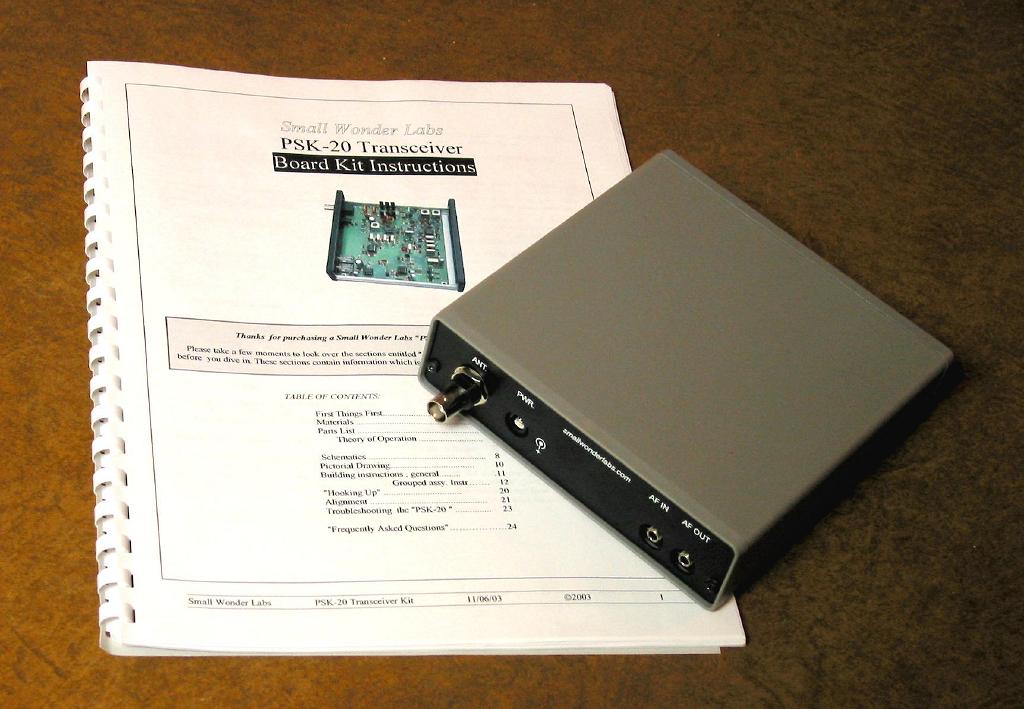
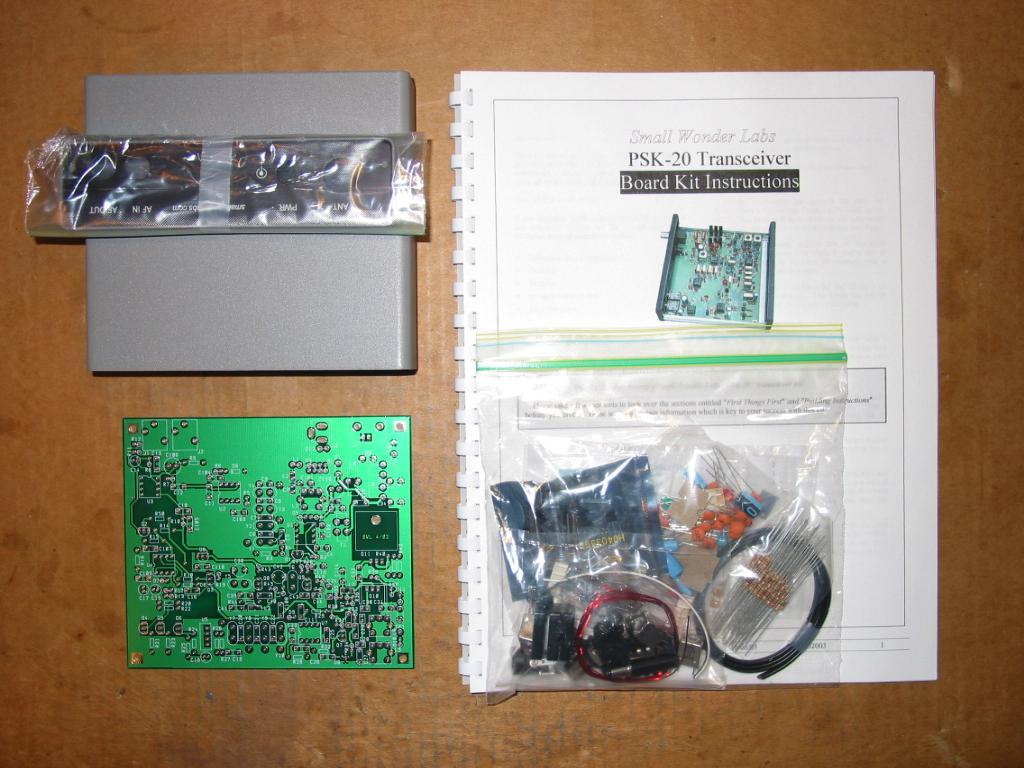
PSK-20 Kit, unassembled
|
The completed kit, with signals
on the waterfall.
|
Praise & Criticism
My only real criticism of the whole kit building process was the
lack
of any testing
as the assembly of the different sections was completed. The
assembly
instructions are grouped into the different stages of the
transceiver
(DC power, RX, TX, AF,
etc) but at the end of each stage there weren't even the most
rudimentary of
tests to verify assembly was done correctly. I would feel much more
comfortable
at first time power-up if I had checked some of these stages first,
even if they
were nothing more than ohmmeter tests (which I did). I would also
like
to see some LED's for 12VDC power and TX, and a power switch. I will
likely add these on my own. Since the alignment instructions refer
to a
specific version of DigiPan software, it would've been nice to have
included it on a floppy or CD (copyright probably prevents that
though). The version of DigiPan referred to in the manual has been
superceded, though the current one is close enough to follow the
same
instructions. The PCB is a quality double sided design with plated
through holes, silkscreen and solder mask. Components were first
quality, and the completed unit fit perfectly in the supplied
housing.
The assembly and tuning instructions were in a nice booklet
and printed in color. The alignment procedure is deceptively simple,
requiring nothing in the way of specialized test equipment. It is
important that it is aligned properly, if not your carrier and
opposite
sideband suppression won't work right. Overall I thought the
instructions were good, and the design well thought out and
implemented. I would recommend this kit to anyone interested in
portable PSK.
Technical
Here are some basic measurements I made on this unit after
construction
and alignment:
(Tested and aligned with Rhode and Swartz sig gen, Agilent
spectrum
analyzer
and Agilent arb waveform gen, 12.50VDC power input.)
- Minimum Discernable Signal: .76 microvolts
- Power Output: 3W with 492mV audio drive (2kHz tone)
- Carrier Supression: -40dB
- Worst Case Opposite Sideband supression: -32dB
- Worst Case Modulation Distortion Product: -45dB
- Spectral Purity: Worst Case was 2nd Harmonic -60dB
Conclusion
I've been looking forward to having a portable PSK setup for some
time,
and
this kit is just the ticket. All I need is my laptop, the PSK-20,
wire
antenna,
a gel cell, and I'm ready to go. The PSK-20 is a well designed kit
using
quality components and I am glad to add it to my stable of QRP
gear.