12.5" Newtonian Reflector Telescope

On family camping trips under dark skies, I found myself looking up and wondering what a telescope might show me. Having children causes one to relive one's own earlier times of discovery. So, I joined the Vancouver section of the Royal Astronomical Society of Canada and borrowed 8" and 10" telescopes. From the city, I managed to get good views of Saturn, Jupiter, and a few Messier objects and decided that I'd like to own a telescope.
After checking prices and reading various telescope-making web sites, I decided to build my own 12.5 inch. Once the mirror gets larger than that, the telescope's cost and weight increase too much for my liking. For best image quality, I wanted the longest focal length that would still allow me to use the telescope without climbing a ladder. The scope had to pack small enough to fit into my vehicle, and be rugged enough to survive trips on logging roads to dark observing sites.
The telescopes I borrowed were frustrating to use due to the small size of the finder scopes and constant fogging of the finders and eyepieces. British Columbia nights are cold and humid. Also, tube currents and long cool-down time due to poor ventilation were problems. So my scope needed a large finder, anti-dew heaters, and a fan to cool the main mirror.


I've included mechanical details in the descriptions of the parts, since that's the kind of information I found useful when I was searching the web for design ideas.
The outside of the secondary ring is made from 3 pieces of rolled 0.060" aluminum sheet, screwed to two internal end-rings that were rolled from 0.25x0.5" aluminum bar. Four pieces of 5/8" wide aluminum channel screwed lengthwise increase the stiffness and are where the frame pipes attach. Overall, the secondary ring has a 16.5" outside diameter and is 10" long. The focuser axis is 4" below the top.
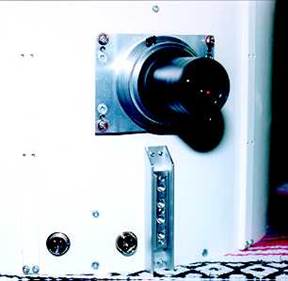
The focuser is one of Garry Wollanski's "Low-Boy" models. It's light weight and has a low profile and smooth motion. I chose a 2" focuser so that I might do photography some day. The focal plane is 0.39" outside of the turned-in position, and overall 9.55" from the secondary mirror. I've added push-pull screws at each corner of the focuser base plate for 4-point adjustment. Also, below the mounting plate are aluminum bars that contain electrical resistors to provide 4 watts of heat. This has worked well to keep dew off of eyepieces.

The 2.14" secondary mirror (pyrex with enhanced coating, from Orion) is glued at three points onto a diagonal-cut piece of 1.5" aluminum pipe that is part of the secondary holder. Three 1-watt electrical resistors for heating are glued onto the back of the secondary using silicone caulking.

The secondary holder shaft is 0.5" aluminum rod that slides through the spider hub and locks with two set-screws. A disk screws onto the top end of the shaft so the holder can't fall out during adjustment. The disk is also a light baffle, casting a shadow on the holder and hub. There's a 3-screw tilt adjustment on the secondary holder for collimation.
Four frame pipes are 46.5" lengths of 1.5" diameter extruded aluminum with 0.060" wall thickness. A the top end, a 1/4-20 bolt locks each pipe securely into a channel on the secondary ring. At the bottom, another bolt locks each pipe into a right-angle bracket at a corner of the mirror box. Originally I had planned to add 4 more smaller pipes diagonally to form a truss, but the straight pipes alone are solid enough for visual use. Bending is very slight, and vibrations damp out in about 2 seconds. With my hand guiding the scope (the usual situation) vibrations dampen quickly and aren't a problem even at 440x.


The mirror box is 18.2" square on the outside and 17.1" high, made from 3/4" birch plywood. The frame poles get bolted to extruded aluminum right-angle brackets at the top inside corners of the box. These force the frame pipes into alignment and hold them tight. Centers of the altitude bearings are 1/2" below the top of the box, and the main mirror surface is 11 1/8" below the top of the box.


Nova Optical Systems made the mirror. It's 2.15" thick pyrex with a 96%-reflective coating by QSP and weighs 20 lbs. The working surface is 12 1/4" diameter, since the beveled edge is 1/8" wide. I have painted the edge black. Nova measured the final focal length to be 64.5", which is f/5.27. Delivery took 3 1/2 months. I'm pleased with the optical performance, which has so far exceeded the seeing conditions. One night in late September, during short moments of good seeing, Jupiter's bands and swirls and the Cassini division of Saturn's rings became clear. I'm still waiting for that "perfect night."
On a few occasions I had the main mirror fog up, especially when the cold scope is brought indoors. When that happens, dust sticks to the water droplets on the mirror surface and leaves a film even after the mirror dries. I added a 10 watt heater to the mirror (resistors glued around the back surface). I sometimes apply a little heat while observing if the air is moist. I apply full heat to the mirror on the trip home after observing so that it won't fog when I bring it into the house.


With the teflon pads in hand, I tested all the formica varieties at the local hardware store and chose the one with the least friction. Formica with a smooth surface actually had high friction and scratched the teflon! The formica I chose has a moderately rough surface texture. The bearings stick a bit, since the rough formica surface impresses itself in the teflon when the telescope is not moving. After a couple of months of use, I had to replace the formica because it's surface wore off and the friction increased significantly. I since added three smaller spring-loaded teflon pads near the center to take 30 lbs of load off the outer pads. After five years of use the bearing friction is still acceptable.

I chose to use an Orion 9x60mm illuminated-reticle finder scope (now discontinued) with an EZ-Finder reflex sight piggybacked onto it. A reflex sight makes for easy pointing at stars, and the finder is big enough to see the brighter deep sky objects. I've put electrical resistors for anti-dew heating on the finders (5W on the objective, 3W on the eyepiece, 2W on the EZ-finder) and they have not fogged yet.
The Orion finder works well, although it has a lot of coma distortion off-center. It also cannot be focused during use, and I can't see the whole field when wearing glasses. My main complaint with the EZ-finder is that the light transmission of it's window is low. Dimmer stars cannot be seen through it. To use it, I keep my eyes about a foot behind it so that my left eye sees the projected red dot and both eyes see the sky. My right eye can then see the dimmer stars that are blocked from the left eye's view by the EZ-finder. With this trick, it's entirely satisfactory.
When I finally assembled all the pieces and installed an eyepiece, the telescope balanced almost perfectly! No counterweights were needed. I had planned for about 10 lbs of counterweight before I decided to omit the diagonal truss tubes.


The scope has survived many logging road trips and does need collimation adjustment after setup. Usually, I don't have to collimate after I assemble it for use at home.
First light was the star Regulus, during the process of setting the frame pole length to place the focal plane where I wanted it. Once the poles were finshed, it didn't take long to find galaxies in Ursa Major, globular clusters, the Ring Nebula in Lyra, and various double stars. Nebulae and galaxies are much clearer at dark sky sites away from the city (Mt Kobau, Manning Park, and Hurley Pass). I've seen the whisps of the Veil nebula in Cygnus, and detected three members of Stephan's Quintet in Pegasus, and seen some of Barnard's dark nebulae.

I held a 35mm camera to the telescope eyepiece and took this picture of the moon.
© VE7CNF 2001 - 2026