Using A NanoVNA For Ham Radio
A Very Useful Piece of Test Equipment.
HOME Ham Projects Links
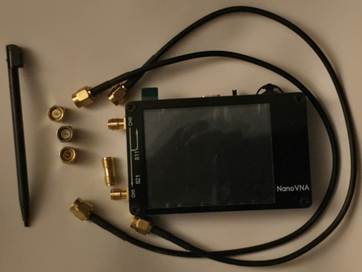
A NanoVNA is a very versatile and inexpensive device. They are light-weight, can easily be transported and used in portable and mobile locations. A dual (1-1/2?) port analyzer that can measure SWR, resistance, reactance, cable length, and frequency response. Information is displayed in graphical and numeric formats. It can use software to display and store data on PC.
NanoVNA Presentation, pdf File
NanoVNA Presentation, PowerPoint File
A NanoVNA takes the place of an antenna analyzer, an LCR meter, and a Time Domain Reflectometer. Some common uses for a NanoVNA include:
*Antenna testing and tuning
--*Standing Wave Ratio measurements
--*Resonance Measurements
*Complex Impedance Measurements
--*Resistance
--*Reactance
*Cable testing and fault isolation
--*Length Measurements
--*Distance to impedance changes
--*Distance to faults
*Testing tuned circuits
--*Filter bandpass
How Does a NanoVNA Work?
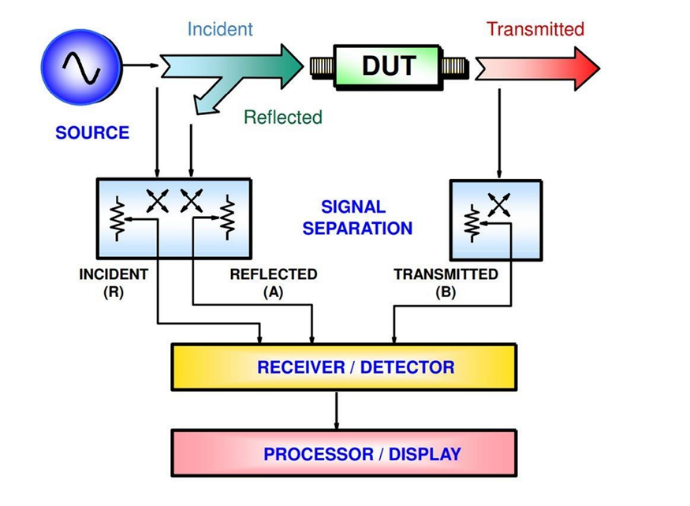
VNA (Vector Network Analyzer) measures the frequency characteristics of reflected power and passing power of an RF Network. NanoVNA measures the following elements:
*Input voltage In Phase/Quadrature signal
*Reflected voltage In Phase/Quadrature signal
*Pass voltage In Phase/Quadrature signal
From here we calculate:
*Reflection coefficients (S11)
*Transmission coefficients (S21)
Calibrating a NanoVNA
A NanoVNA is usually sold with a set of calibration standards, two SMA male to malecoax jumpers, and an SMA female to female barrel connector. The calibration standards are SMA male connectors which are open (no center conductor), shorted, and 50 ohms.
The calibration of a NanoVNA can vary with temperature and battery voltage. It is the best practice to calibrate for the band to be tested just before testing. The calibration can be saved, but this should not be considered a long term calibration.
A single port measurement, like antenna measurements, only requires calibration with open, short, and load. Isolation and through are only relevent to two port measurements, like characterizing a filter or measuring insertion loss.
Things to Remember About How a NanoVNA Works.
A NanoVNA sources a signal up to 300 MHz. Higher frequencies are sourced at or below 300 MHz and measured on a harmonic. So as the harmonic goes up (second order, third order, etc.) the uncertanty increases.
A sweep is an analog function, so the NanoVNA does not actually do a sweep; it steps between the "start" and "stop" frequencies. The norm for a NanoVNA is to take 101 measurements for a selected range.The first measurement is the selected "start" frequency and then it counts up 100 times. The last step makes the 101st measurement at the "stop" frequency. The "H" model has a menu selection to increase to 401 measurements. With the limited number of measurements, the range has to be considered carefully. The wider the range, the wider the steps. For example, if you set the "start" at 3 MHz and the "stop" at 30 MHz that is a 27 MHz. 27 MHz divided by 100 is 270 kHz steps, which means you may only have one measurement in some HF bands, and miss some entirely. It is important to select individual bands for testing.
When connected to computer and using NanoSaver you can select the number of segments. This means that the computer will control the NanoVNA to add measuremtn points. In the example above, 3 to 30 MHZ, by setting the software for 10 segments we can reduce the measurment step from 270 kHz to about 27 kHz. This allows a more detailed analysis of a wide frequency range.

Updated 02/08/2026