
An Experiment with a Rocket Stove - page 6
Oct 1, 2007 - A full scale stove was built around this design and is currently being tested at a school in central Tanzania.
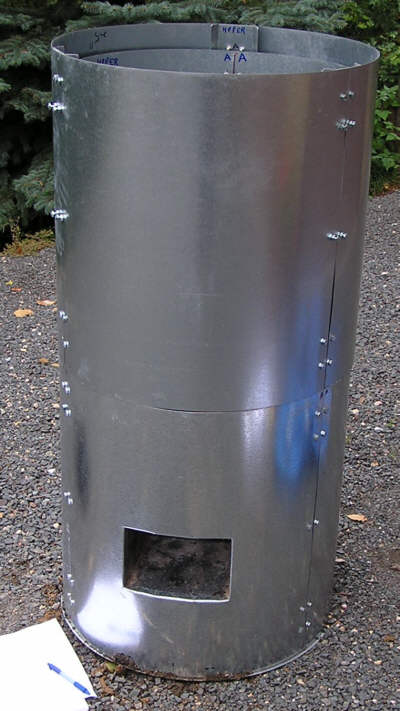
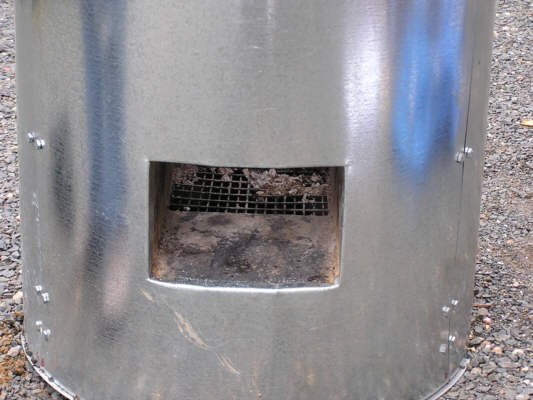
This unit consists of a complete stove and is a modification of the largest heating unit design that I tested. It was built to be taken on a plane as checked baggage, so there would be minimal cost. The fire chamber is make from wire-feed welded, 3/16" hot rolled steel. The original "test-of-concept" design was made from part of the 8" chimney pipe, with some extra pieces pop-riveted on to form the wood inlet. The design was changed from circular to rectangular because it was easier to fabricate for use with a commercial insulated chimney. The stove pieces are held together with 1/4-20 bolts and nuts, 1/4 "washers, and lock washers. The chimney was made from an off-the-shelf, triple-walled, 8" diameter x 24" long, insulated chimney section. The rivets on one end of the section were drilled out, the rock wool insulation removed, then the chimney was cut to the required length, and the end pop-riveted back on. The rest is made of sheet metal to save weight. Assembled, it's outside diameter is 24", it stands 4 foot tall, and the inner skirt around the pot is 22" diameter. The stove is bolted down to a concrete slab to prevent tipping and steps were built on two sides to allow the cooks easier access. The stove could have been made simpler and cheaper by eliminating the outer shield and simplifying the support structure. Doing that would have left the hot skirt, chimney, and the very hot fire chamber exposed. For the safety of the operators I decided that some measure of protection should be provided. The exposed fire that might ignite clothing is restricted to a small area. The outer shield gets fairly hot in some spots, but not enough to burn the operator by a brief touch. It also probably helps the efficiency by reducing heat loss. A 6" diameter, 3/16" thick steel baffle that drops into place 2" above the top of the chimney is not shown. It would be removed for startup and then lowered back into place by the operator prior to putting in the cook pot to divert flames from hitting the bottom of the pot. In the future, a permanent mount that lets it swing out of the way would be better. Ashes are removed with a hook-shaped tool out either of the two air inlets on the back side.
Assembled stove.
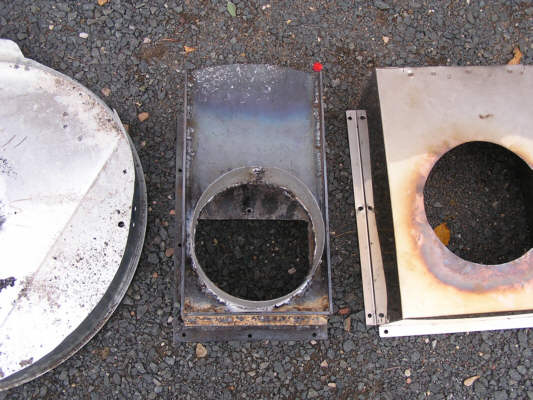
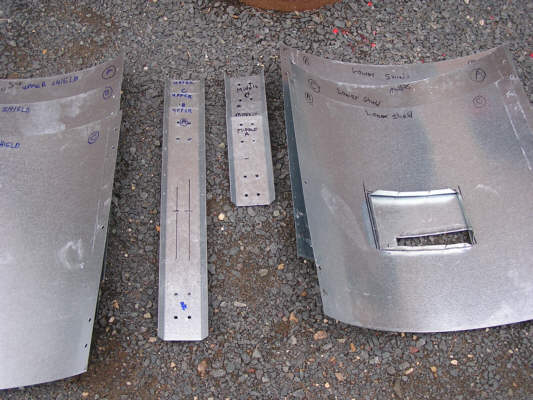
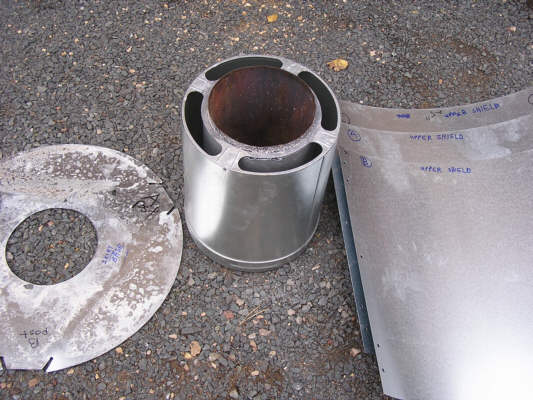
These are some pictures of the stove made during disassembly for shipping.
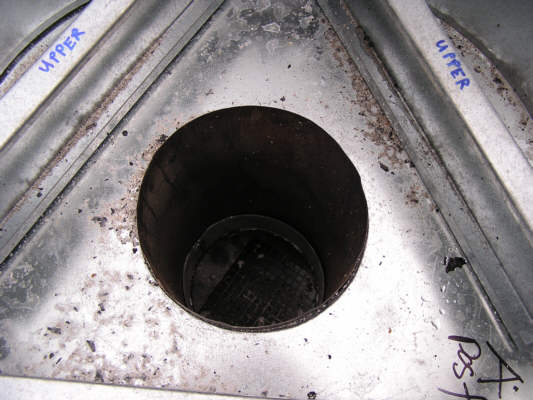

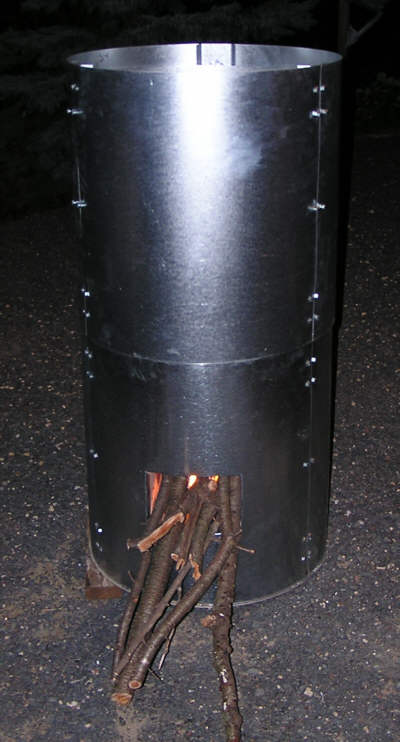
This is a picture of the first and only test of the stove, without a cook pot, just after we finished building it. This was two days before the stove had to be ready for the flight out. Due to severe time constraints, there were no "bells and whistles". There wasn't time to make a top cover for the stove or any other improvements.
In Africa - pictures from the first few days of use.
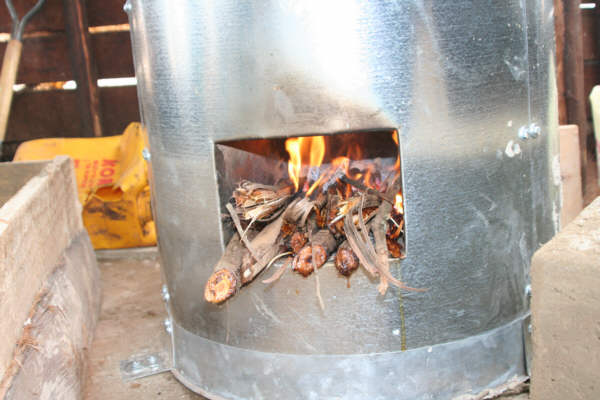
Stove is bolted to a concrete pad and concrete steps were poured to make access
easier for cooks. Burning thin bark, which burns very quickly, along with the
wood allows the flame to get near the outside, causing some soot above the wood
inlet. The stove is "turned-down" by reducing the amount the amount of new wood
added and how fast the burning sticks are pushed in. I haven't heard how low the
stove can be run before smoking occurs.

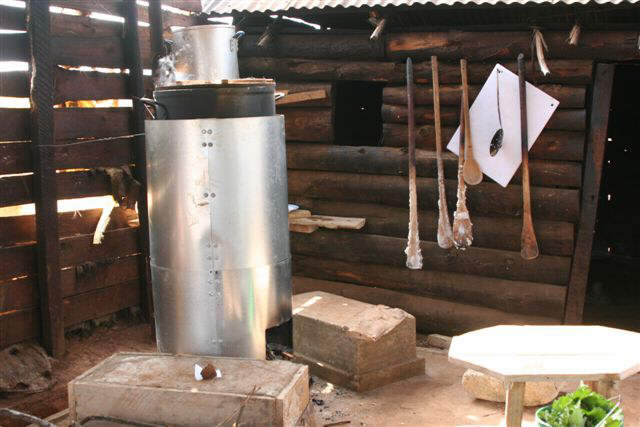

The stove is to replace a large "three-stone" fire that is used for cooking ugali, potatoes, beans, and rice. It is also being used for pre-heating large quantities of water, since it is much more efficient than the cook fires and puts out no smoke. The cook pot used with the stove is about 21" diameter, 18" deep and can hold about 100 quarts. The water can then be removed to other pots for cooking food with the present open fire method. Heating water to boiling takes lots of energy and time, so this can greatly reduce the time that cooks are exposed to smoke and the amount of wood that needs to be gathered. The technology is close enough to their present cooking methods and requirements, not complicated, and due to the simple design, should be reliable, all of which I believe are keys to acceptance. The cooks began using it the day after it was installed and are reportedly very pleased with it. The people at the site decided they didn't need the drop-in baffle to divert flames from the pot so it was left off. I hope to get an update on the success of the design in about six months or so. In making this stove I learned some things which should help, hopefully along with some feedback on the current test model, if I try to design a future version.
Several months ago I knew nothing about stove designs and I had never even heard of a rocket stove. At the request of a member of a local church that had seen my solar cooker experiments, I began doing some research on high-efficiency stoves. He wondered if the technology would be feasible for a secondary school at a project in central Africa. Starting with learning the basic principles about how efficient stoves work, it took almost a month and a half of testing, but I eventually came up with this design to meet their requirements. I appreciate the help of the two people, experienced at working with sheet metal, who donated time and materials, for helping me turn an idea on paper into an actual working stove.
I was surprised to find that a simple technology I had never even heard about could allow someone like me to make practical, efficient cook stoves. This efficient method of burning wood can significantly lower the volume of wood required for cooking. If designed and used properly, it is capable of reducing the danger to the operator from the quantity of smoke that is breathed in and also the dangers of burns associated with open fires.
As with all the other test designs, this one draws from the work of others. It's easier to modify and hopefully improve on something that exists and more importantly works, than to start from "scratch" and make someone else's mistakes all over. On a very limited budget this is an important consideration. As of today, all the experiments that I have conducted on solar cookers, rocket stoves, and the one that I've just started, have set me back less than $500. I didn't pay for the materials for the Africa stove, those were donated. Cheaper than a trip to a Vegas casino, and I've had a lot more fun.
From my testing I came up with a general guide for minimizing smoke here.
L.B.