

An Experiment with a Rocket Stove - page 7
Nov. 18, 2007 - A smaller stove built around the institutional stove design
This unit consists of a complete stove and is another modification of the
largest heating unit design that I tested. It was built to be taken on a plane
as checked baggage, and I also wanted to lower the production cost. Where the
other stove would take a lot of time for manufacturing and assembly, the idea
for this stove was to make one that could be assembled in 5 min. or less. The
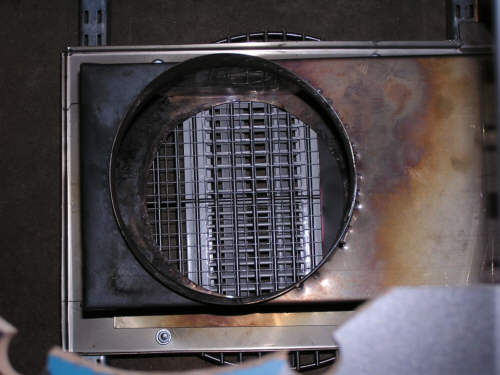
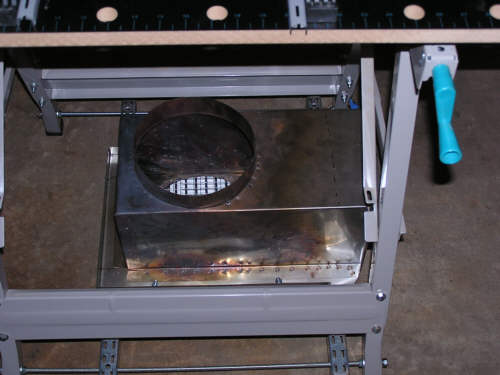
fire chamber that I used is made from spot-welded stainless steel sheet metal and was the first
trial version of the fire chamber built for the Africa stove. It warped with the
high heat ( 1000 + degrees F) when tested, and 3/16" hot rolled steel
(Wire-feed welded) was chosen for the fire chamber in
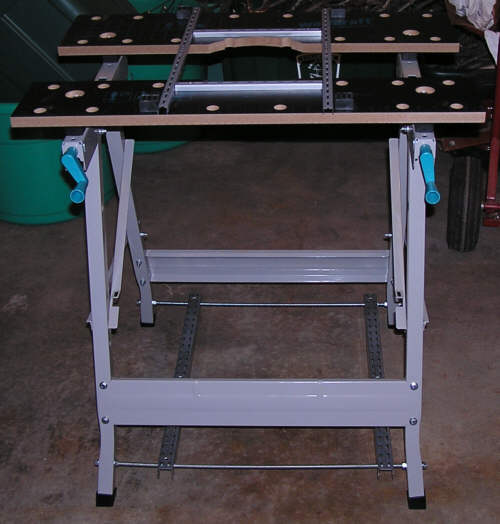
the Africa stove instead. The pieces of this new stove can be pulled apart and the stand (A
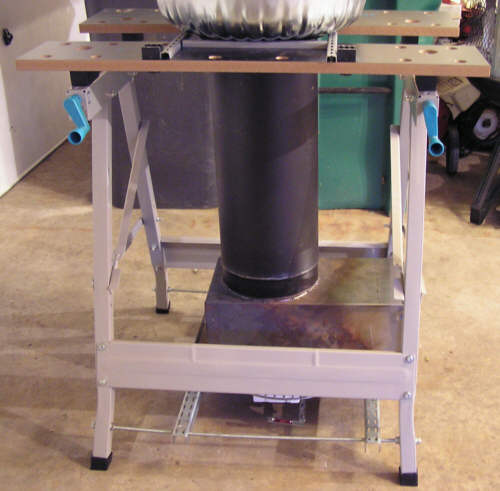
portable workbench) folds up. The chimney was made from a 6" black vent pipe,
with a 6" to 8" adapter on the bottom to fit over the 8" fire chamber flange. An 8"
vent pipe fits over the 6" pipe for a layer of insulation. It stops where the
adapter widens to 8" on the bottom and 1 1/2" inch short of the end of the 6"
vent on the top. Three one-inch long metal coupling nuts center the 6" pipe at
the top end. A circular trim plate for a 6" pipe covers the open end of the 8"
pipe. The 6" diameter chimney was cut to 16" long. The 8" chimney sleeve was cut
to 18 1/2" long. The skirt is made from a 17" I.D. x 11" high steel bucket with
a 6" diameter hole cut in the bottom. A 250 lb. capacity, fold-up workbench
(#2401563-Menards-$30 ) supports the stove parts. A 33 qt. covered canning pot
(About 15" diameter x 10" high) was used for water heating tests. Cook pot
(Granite Ware) and bucket (Behrens) were from Fleet Farm. Cutouts were made in
the wood bench top to clear the chimney. Assembled, the stove stands 44"
tall. The fire chamber and chimney are supported by threaded rods on each side
and two shelf brackets with two V-shaped grooves cut in each of them. Distance
from the bottom of fire chamber to floor is about 3 1/2". The wood inlet opening is
8" wide by 7" high, but 3" long metal strips hanging over a metal rod restrict
the top of the inlet if no wood is pushing them back. A grille covers the 7"
diameter air inlet under the chamber to support the burning wood, but allow
ashes to drop through. The air inlet is centered under the chimney.
The hot skirt would need
some kind of protection around it. The chimney and the very hot fire chamber are
shielded fairly well by the workbench structure. The insulating cover over the heating
chamber was eliminated to help combat the warping problem encountered when it
was used on the other stove. With no insulating
cover, the efficiency may drop somewhat. A small steel baffle above the top of
the chimney should probably be added. It would be removed for startup and then
lowered back into place by the operator prior to putting in the cook pot to
divert flames from hitting the bottom of the pot. The skirt needs to be secured
to the bench top and possibly a sheet metal covering made for the wood top
surface. This test stove, except for the fire chamber, was put together in a day in
my garage with no special tools.
These are some pictures of the stove made during assembly.
Nov. 19, 2007 - This is a picture of the first test of the stove, with
a 33 qt. cook pot. The pot was filled with 5 gallons of cold water and heated to
boiling.
11:20 am Start of test (Water at 57 F)
11:33 am 180 F
11:36 am 200 F
11:37 am Boiling
11:38 am "Rolling" boil
Time from cold to boiling - about 17 minutes for 5 gallons of water.
I used bricks underneath to protect the driveway. A damper I put on the air
inlet, under the fire chamber made no difference, open or closed, so I'd
eliminate it. The fire chamber could probably be smaller, especially the height,
without hurting the performance. I was told that the full-size "Africa" stove,
with the same size fire chamber,
heated 24 gallons of water to a boil in about 1 1/2 hours, which works out to
roughly the same heating rate per gallon.
This stove was made as a test of a design. The materials that I used may
not be suitable for permanent use. The galvanized steel bucket got hot enough to
discolor the side. The zinc plating could be a health hazard if overheated. A
skirt made from sheet steel, without a zinc coating, would be better.
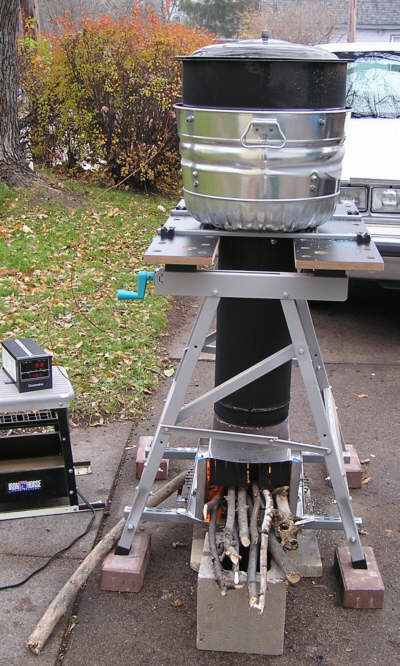
Second Test - Nov. 24, 2007 - Removed 3" metal strips on top of wood inlet. Blocked off top 3" of wood inlet with sheet metal instead, leaving inlet 4" high by 8" wide. Removed adjustable damper restriction from air inlet. Results of a second test of the stove, with same 33 qt. cook pot. The pot was filled with 5 gallons of cold water and heated to boiling. Air temp - 37 F. Water temp. - 60 F. Strong wind. Ten minute stove warm-up. Temp. control used for readings with type J thermocouple in water as before.
1:40 pm Start of test
1:50 pm 146 F
1:54 pm 200 F
1:55 pm 209 F - Rolling boil
1:56 pm 213 F - "
"
Results of second test- About 15 minutes to heat 5 gallons of water to boiling. The wood inlet (4" x 8") was kept about 1/2 to 2/3 full. There was a little smoke during most of the test. I was probably feeding wood in at too high a rate. The strong side wind may also have had an effect. Wind in previous experiments has caused smoking, as it affects the draft. It would seem that wind would help with the chimney draft, but in reality, it can reduce the chimney air flow. Unless you have a reliable way to take advantage of the wind flow, it's best to have no wind.
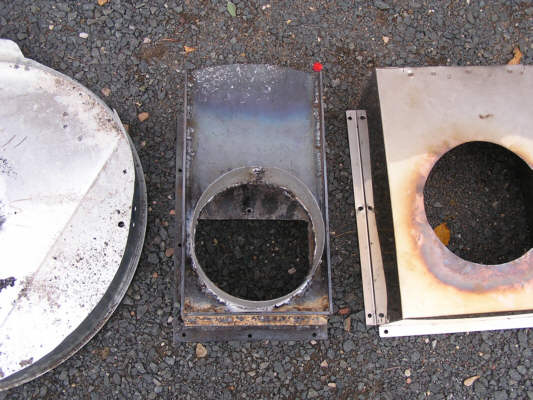
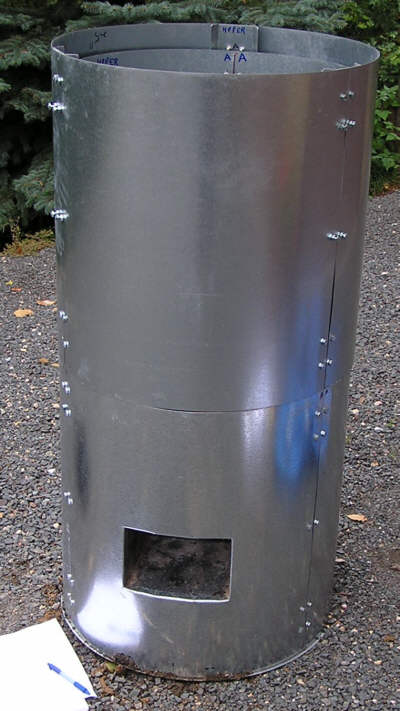
Compare the fire chamber and fully assembled unit of the "Africa" stove
shown below. Most of the
parts for this stove were built in a sheet metal shop and took many hours of
work. Note the stainless steel insulating cover for the fire chamber (Right side
of the left picture below) that
originally was made for the stainless steel fire chamber that I used for this
test stove.
A stove using this general design and size could be used to cook food for a small business, a group of families, for heating large quantities of water for cooking, or for pasteurizing water along with a low-cost water pasteurization indicator device. It takes much less energy to reach 70C-80C than to boiling (100C / 212F). The stove can be assembled very quickly. The fire chamber could be made from brick if it sat on the ground and had the air feed from the side. Altogether, the parts cost for the stove was under $100.
From my testing I came up with a general guide for minimizing smoke here.
Jan. 2008 - Testing with a high-temp. type "K" thermocouple showed a maximum temp. around 1600 F in the center of the fire chamber.
L.B.