

An Experiment with a Rocket Stove - page 9
Previously I tried making a rocket stove from a single 8" diameter by 24"
long, black vent pipe. I decided to try making an improved version. This time I
allowed myself to cut some parts from the vent pipe. I used steel "pop-rivets"
as fasteners, but screws or spot welding would also work.
I started by cutting 5" off the 24" length to make the legs, baffle, and pot
supports, leaving an 8" diameter by 19" long section for the stove. I cut out
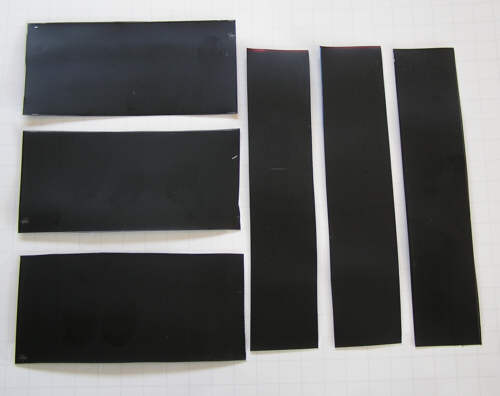
three 1 1/2" x 5" strips for legs and three 2 1/2" x 5" strips for pot supports.
The remainder was used to make a baffle to separate the fuel and air. The baffle
has a 4" radius so it covers one-half of the fire chamber. That way only the
ends of the wood burn. It also heats and creates turbulence in the incoming air.
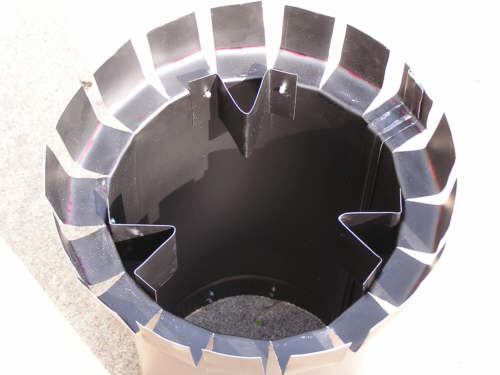
The opening is 4 1/4" wide and the top is 5" from the base. The two 2" high tabs
are bent inwards to help support the fuel/ air baffle. This gives a 3" high by 4
1/4" wide fuel opening. The slits cut at the top are 3" high by 1 1/2" wide. From the
bend line at the bottom of the slits to the base is 16". The pot supports are
mounted about 1/2" above the bend line to allow hot gas to pass under the pot
and up along the pot sides.
Below are bottom and top views of the stove.

5/23/08 - Test to heat 1/2 gallon of water to boiling. Air temp. = 68 F,
Water temp. = 55 F
Clearance from tabs to side of 7 1/2 qt. cook pot about 3/8". A piece of
scrap metal was used at the inlet to add support to the wood.
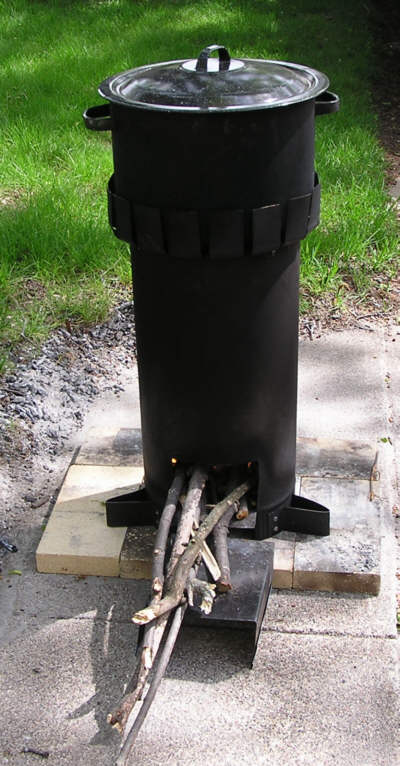
3:17 pm Start - Water temp. 55 F
3:30 pm "Rolling" boil
Time to boil 1/2 gallon of water roughly 13 minutes. A little smoke after putting on pot of cold water. Cleared up after about a minute. Wood inlet about 1/2 full. Fire inside stove was spinning, turbulent, indicating a strong draft.
Improvements over previous stove made from one piece of 8" vent pipe
Making up the pot supports separately from the stove allows the hot gas to
flow more freely. The tabs on top form a better skirt since they aren't being
used to support the cook pot. The shorter stove is more stable and the addition
of legs at the base also adds stability. The baffle keeps fire away from the
wood inlet, warms incoming air, and creates turbulence. Wood use seems less than
the original design. Ashes could also be
pulled out through the air inlet if needed.
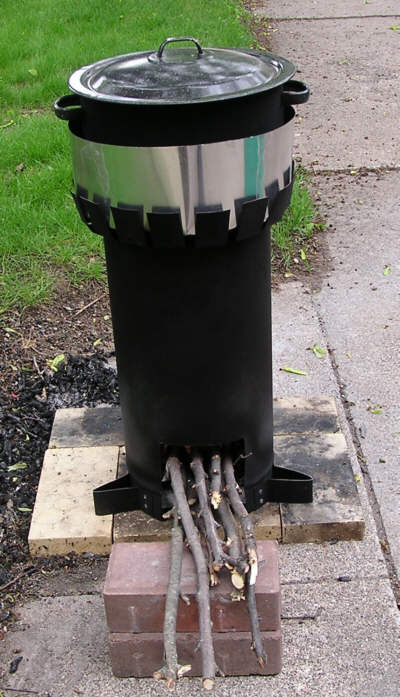
May 26, 2008 - Added 4" high aluminum flashing skirt to top of stove.
Air temp.= 64 F, Water temp.= 55 F, 1/2 gallon water in 7 1/2 qt. covered
pot, light breeze, left pot covered through test, pot to skirt clearance about
3/8", bricks were used to support wood.
12:13 pm 55 F Water - Start
12:24 pm Boiling
About 11 minutes to boil. Slight smoke after adding pot of cold water for first minute. The fire didn't have as large a flame as the 8" vent pipe design (From 2007) because half the air inlet was blocked off with the baffle. While the ashes didn't block the air inlet completely, ash buildup would still be a problem if the stove was operated longer than about 15-20 minutes without cleaning. Moving the top of the wood inlet and the fuel/air separator baffle up an inch or so might not be a bad idea.
From my testing I came up with a general guide for minimizing smoke here.
L.B.