An Experiment
in Solar Cooking - page 4
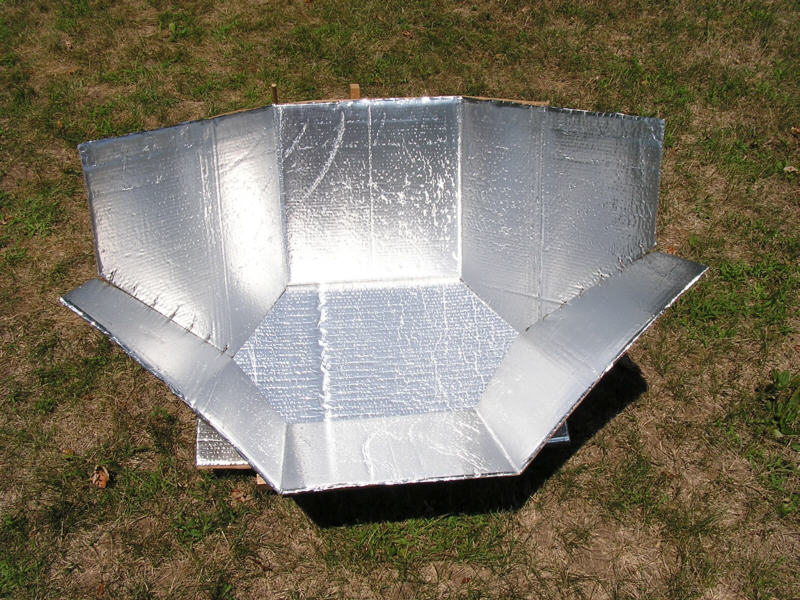
A cooker with extended time between adjustments
The purpose of this experiment was to build a cooker with good performance, but
requiring less frequent adjustment, more like the comparison cooker. Again, this
design used the same 18"x18"x28" (End flaps not included) 3M cardboard storage
box as before. With the sun at either extreme of its range, each opposite end
acts as a corner reflector. When the sun nears the middle, the center section
takes over. The center sections of the reflectors are at about 40 degrees from
vertical, the ends about 25 degrees. The last design was meant to be adjusted
every half to one hour. This one could hopefully go for two or three hours. I've
made the assumption that someone can be available for oven adjustments, but with
this design, the interval between adjustments could be longer. This one is also
foldable. The reflector halves fold up, and in use they are temporarily tied to
the base with string.
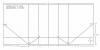
Construction - See above drawing
I cut two rectangular, 18" by 28" pieces for the base. Glued them together for
strength.
Cut two 18" by 47" sides from box.
Drew a line along one side (about 1/4" from the edge) with a straight-edge to
use as a straight reference line. Cut along the line. All measurements will be
made from this line.
Drew a line from top to bottom, midway between ends.
Drew a line 7" away from center on either side (These are fold lines).
Drew a line 13 3/8 away from center on either side.
Drew a line 3 3/4" away from cut edge from end to end.
Made a mark 9 1/2" from cut edge on each outside edge of ends.
Made a line from "A" to "B" and from "B" to "C" on each side of center (See
above drawing ).
Cut from "A" to cut edge.
Cut from "A" to "B" to "C" (The 14" x 3 3/4" tab left will be bent outward to
secure the reflectors to the base).
Made the second reflector the same way.
Coated the base and reflector sections with heavy-duty aluminum foil.
When dry, made 7 holes at 2" intervals from "B" to "C" about 1/2" from edge (A
cardboard strip could be glued along that edge on the outside for re-enforcing).
Made bends inward along the 7" lines. Bent the 14" x 3 3/4" tab outward 90
degrees.
Laid the two reflectors together (Shiny side facing) and ran a string from
bottom to top through the holes.
Set the reflectors on the base and pushed the ends toward each other until the
bottoms lay flat on the base. The distance between the the top of the center
sections of the reflectors is about 30".
Adjusted the slack out of the strings to hold the ends together but still let it
fold flat.
Made holes through the tabs into the base and used string to tie the reflectors
down.
Overall length of cooker - 38", width - 30"
Center section angles about 40 degrees from vertical, ends angled about 25
degrees
Reflector surface of fold-up design has about 18% more area than comparison
cooker
Test #1 - 2 hour water-heating test of fold-up cooker vs. comparison
cooker - July 30, 2007
This was a test for heating from the cookers limit.
The sun gets overhead about 1:30 pm. Both cookers were rotated to where they
would be properly adjusted for that time (About 25 degrees from the sun's
position at the start of the test).
Heating test of 1 1/2 cups of tap water in black painted glass canning jars
(Slightly loosened lids). Air temp. was 77 F, light breeze, no clouds.
10:35 am Water temp. 77 F (Start of test)
12:35 pm Water temps. - Fold-up cooker 181 F, Comparison cooker 144
F
Air temp. was 89 F at end of test.
Test #2 - 1 hour water-heating test of fold-up cooker vs. comparison
cooker - July 30, 2007
This was a test for heating with the cookers near mid-day.
Lowered elevation of cookers, but didn't rotate the cookers. Air Temp. was 89 F,
light breeze.
12:40 pm Water temp. 83 F (Start of test)
1:40 pm Water temps. - Fold-up cooker 164 F, Comparison cooker 137 F
Air temp. was 92 F at end of test. The sun was at its peak somewhere around 1:15
to 1:30 pm.
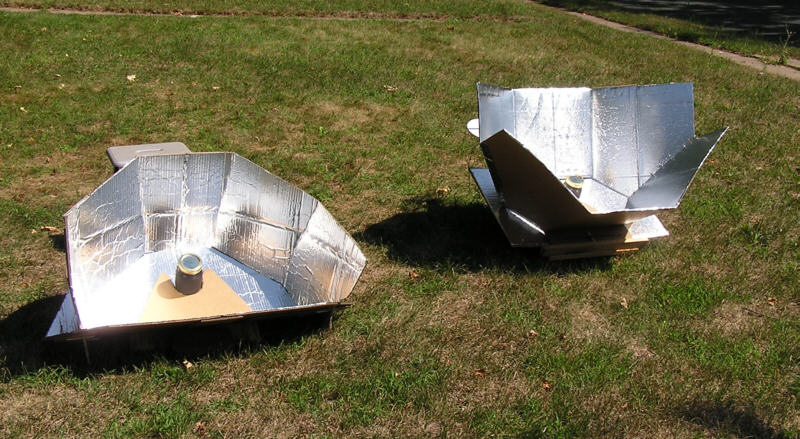
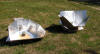 Comparison cooker is on left, fold-up cooker on right
Aug 2, 2007, 11:00 am. - Put a one-third pound hamburger patty in an
8-inch diameter, painted-black covered aluminum pan. Set pan in the center of
the fold-up cooker. Cooker was aimed about 10 degrees away from the sun.
One-half hour later I checked it and the burger was thoroughly cooked in its own
juices (Overcooked, actually). Next time I'd use a grille-type support with
short legs inside the pan to keep food up out of the liquid, and also check it
sooner.
Summary
This fold-up design performed much better than the comparison cooker I used as a
reference. The symmetrical reflectors capture more sunlight than the open-sided
design, and the 18% increase in surface area probably helped. I believe it could
have gone for three hours without adjusting, if necessary.
The angle of the ends (25 degrees in this case) ultimately determines the limit
that the cooker will work at. As the sun begins approaching 90 degrees to the
corner reflector surface, less and less light is reflected into the cooker. This
cooker has a maximum useable window of about 50 degrees (25 degrees from
vertical on each end). It would be better to use the center 40 degrees for best
heating. The angle I chose for the corner reflectors ended up being a compromise
between widest range and good heating.
An angle adjustment, like a board, with something to prop up one side is useful
if the sun doesn't track directly overhead (like the Twin Cities area). Whatever
design is ultimately chosen to cook with, there will be a learning curve to see
how much time different foods require.
In this design, as well as the last one, food could be suspended by a simple
tripod instead of sitting it on the base of the cooker to avoid possible
problems with spilled food when the base is tilted.
NEXT PAGE
PREVIOUS PAGE
HOME PAGE