

An Experiment with a Rocket Stove - page 10
Previously, I tried making an "improved" rocket stove from a single 8"
diameter by 24" long, black vent pipe. This time I wanted to make a more
efficient stove based on the original concept of using a small diameter chimney.
An outer cover acts as a support for the cook pot. This design, as in the other
two, is made to hold up to a 10" diameter cook pot. As before, I used steel
"pop-rivets" as fasteners, but screws or spot welding would also work.
The legs, baffle, pot supports, heat chamber/chimney, and outer cover
were all made from a single 8" diameter x 24" stove pipe. The outer cover uses
about one-half of the material. It stands about 10 1/2" tall. While the design I
settled on is more time-consuming to build, the idea was for the smaller heat
chamber/chimney to make the stove more efficient in wood use, and more stable,
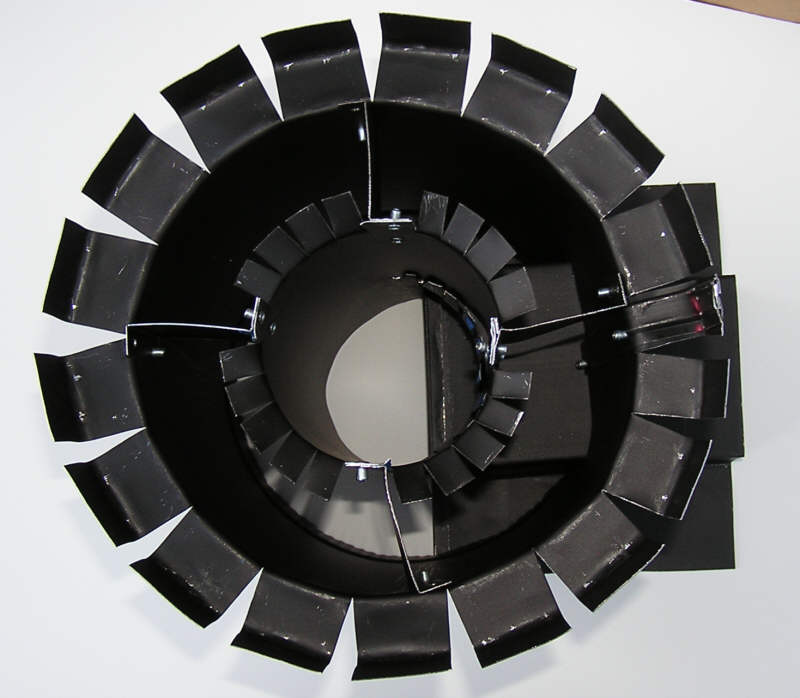
while not using any more sheet metal. The following are some views of the
finished stove. Details of how I built the stove are
on this page.
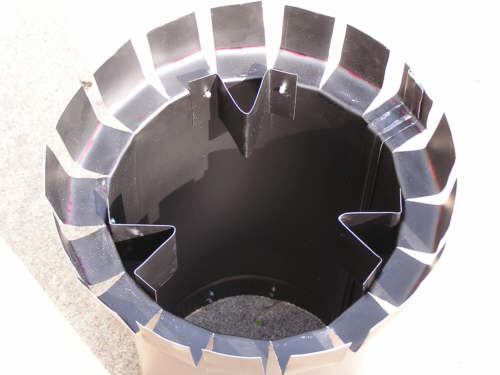
Below are bottom and top views of the previous stove design (rocketstove9.htm) for comparison. Note the size difference in the wood-burning area from the new design. Both stoves were made from a single 2 foot chimney pipe. The new stove is only about 10 1/2" tall, rather than 18".

4/15/2010 - Test #1 to heat 1/2 gallon of water to boiling. Air temp.
= 65 F, Water temp. = 64 F, No wind
Clearance from tabs to side of 7 1/2 qt.(9 1/2 diameter) cook pot about
1/2". A brick was used at the inlet to add support to the wood.
3:11 pm Start - Water temp. 64 F
3:16 pm 156 F
3:18 pm 197 F
3:19 pm Boiling
Time to boil 1/2 gallon of water roughly 8 minutes. Some smoke throughout the whole test, but far less than an open "camp" fire. Wood inlet about 2/3 full. Fire inside stove wasn't burning as aggressively as with previous designs. The flames were touching the cook pot, which may be keeping the gas from burning completely. Not much "draw" from the short (5") chimney to bring in air.
4/15/2010 - Test #2 to heat 1/2 gallon of water to boiling. Air temp.
= 68 F, Water temp. = 60 F, No wind
For this test I tried using a little less wood, which would lengthen the heating
time, but possibly cut down the smoke.
4:37 pm Start - Water temp. 60 F
4:43 pm 150 F
4:45 pm 171 F
4:47 pm 195 F
4:49 pm Boiling
Time to boil 1/2 gallon of water roughly 12 minutes. Some smoke through the first half of the test, but less than in test#1. Less wood used gave lower flame height. Again, not much "draw" from the short (5") chimney to bring in air. The bottom of the heating area tends to fill up with ash, lowering the air flow, as in test#1.
4/16/2010 - Test #3 to heat 1/2 gallon of water to boiling. Air temp.
= 55 F, Water temp. = 57 F, A steady breeze blowing on the stove
For this test I tried supporting the entire stove with a 1" shim under each
side, to assure that air flow restriction was not a problem.
12:20 pm Start - Water temp. 57 F
12:25 pm 135 F
12:28 pm 172 F
12:30 pm 198 F
12:36 pm Boiling
Time to boil 1/2 gallon of water roughly 16 minutes. Some smoke through the first half of the test, but less than in test#1. Less wood used gave lower flame height. While more air flow should have helped, the flame was about the same as before. The stove also has to be capable of drawing the air in, to do any good. The large increase in heating time shows how much even a light breeze can rob heat away from the stove.
4/16/2010 - Test #4 to heat 1/2 gallon of water to boiling. Air temp.
= 55 F, Water temp. = 58 F, A steady breeze blowing on the stove
For this test I tried cutting two 1 1/2" wide x 1" high openings at the base of
the fire chamber, to allow more air in when the ashes build up (instead of
holding the entire stove in the air), to increase the air flow.
1:16 pm Start - Water temp. 58 F
1:30 pm 178 F
1:38 pm Boiling
Time to boil 1/2 gallon of water roughly 22 minutes. Compared with test#2, more air flow should have helped, but the wind blowing, again caused a large increase in heating time.
4/16/2010 - Test #5 to heat 1/2 gallon of water to boiling. Air temp.
= 58 F, Water temp. = 60 F, A steady breeze blowing on the stove
For this test I cut a 4" high, 10" diameter "skirt", out of a piece of aluminum
flashing, to fit inside the top of the outer cover. It should channel the hot
exhaust along the pot, and help with the wind problem.
2:11 pm Start - Water temp. 60 F
2:17 pm 150 F
2:20 pm 186 F
2:22 pm Boiling
Time to boil 1/2 gallon of water back to about 11 minutes. Adding the 4" skirt seemed to solve the wind problem. It also helped to increase the "draw" a little, like lengthening the chimney.

Conclusions:
Adding a skirt to the top made a big difference in the heat transfer to the pot.
The first two tests might have been a little faster, and smoked less with that
addition. The hot gas needs to be kept near to the cook pot for best heat
transfer. Increasing the length of the very short chimney by another 5, or 6
inches, would probably increase the efficiency, draw in air better, and cut out
most of the smoke. The experiment was designed around a single piece of
stovepipe, but that was an arbitrary goal which was set by me. Increasing the
overall height of the stove by 6", or so, to accommodate a little longer
chimney, and adding a skirt to the top would probably make a pretty high
performance wood stove - one that used far less wood than any open fire. Also,
the tabs at the base of the outer cover could be made longer if you used more
material, for increased stability.
From my testing I came up with a general guide for minimizing smoke here.
L.B.