2:10 pm 85 F
2:18 pm 200 F
2:25 pm 222 F
2:30 pm 234 F
2:35 pm 245 F - light clouds
2:40 pm 249 F - "
2:45 pm 259 F - back to clear sky
2:50 pm 264 F
2:55 pm 268 F
3:00 pm 272 F
3:05 pm 276 F
3:10 pm 279 F
Top temp. - 282 degrees F
An Experiment in Solar Cooking - page 2
July 9, 2007
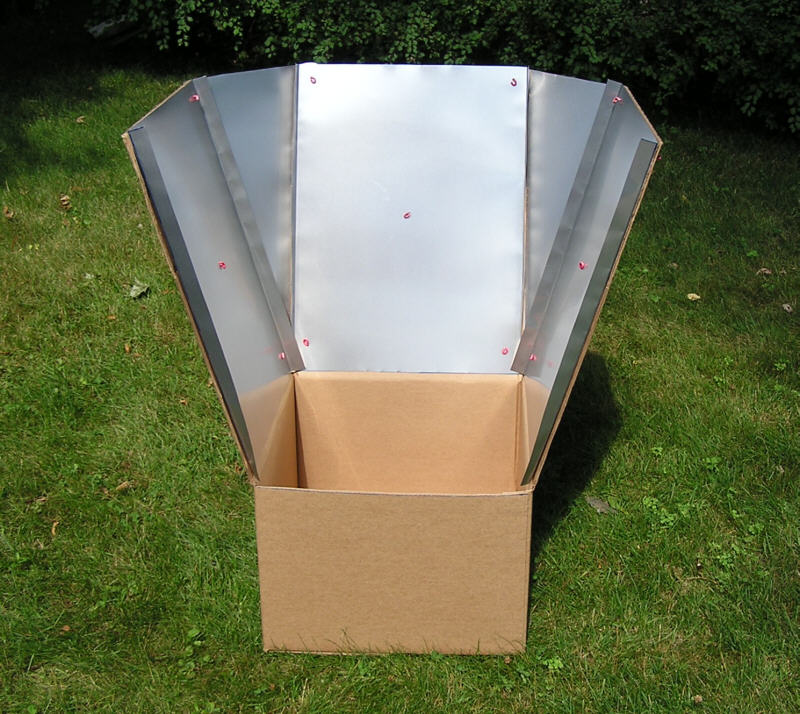
An experiment using aluminum roof flashing instead of heavy-duty foil for the
reflector material
A roll of 20"x 10' of aluminum flashing cost about $10.
Used the same 18"x18"x28" size (Size doesn't include the flaps) 3M
corrugated cardboard storage box as before. Didn't cut off the top tabs on this
design. Each reflector side is 18" wide by 24" high ( Previous foil reflector
panel was 18" wide by 15" high ). Used flashing material to make corners. Edges
of reflectors bent at 90 deg. for rigidity. Reflector panels held onto cardboard
by wire hooks through five drilled holes (Floating, rather than glued down, to
avoid expansion/contraction problems of foil) Same metal bushel basket
wrapped in blanket, painted flat black inside, with 10 lbs. of pea gravel
covered by 12" diameter aluminum circle painted flat black. The glass cover
doesn't completely cover the basket - about 1/2 " at top middle of the basket is
left exposed to the outside (In a real world situation some water vapor needs to
be released to avoid condensation on the cover). T.C. probe touching metal
circle, about 3" from center.
Mostly sunny day, scattered clouds, light breeze, Air temp. about 85 F.
2:10 pm 85 F
2:18 pm 200 F
2:25 pm 222 F
2:30 pm 234 F
2:35 pm 245 F - light clouds
2:40 pm 249 F - "
2:45 pm 259 F - back to clear sky
2:50 pm 264 F
2:55 pm 268 F
3:00 pm 272 F
3:05 pm 276 F
3:10 pm 279 F
Top temp. - 282 degrees F
Summary
As before, the top temp. is reached in about one hour. The flashing I bought had
a brushed finish and some kind of clear coating, not as shiny as the aluminum
foil in the previous reflector panels. The greater surface area (About 50%
greater) increased the final temperature a little, but the heat loss may be
close to balancing out the heat gain in the 280 - 290 degree range unless the
insulation around the center (And maybe the lid) is improved. Polishing the
aluminum reflectors to a higher shine would probably increase the temp. also.
Ultimately, because the oven becomes increasingly more inefficient as the temp. rises, it may be impractical (Or too costly) to make an oven that operates consistently over about 300 F. Controlling heat losses from all sources becomes increasingly more important at higher temps.
Reflectivity Test - Aluminum Foil vs. Aluminum Roll Flashing
Made a setup using a lamp and photo light meter. Measured light reflected
off test materials. Settings - ASA 100, speed 1/125th second. The lower the
f-number, the less light reflected. From f 2.8 to f 4 is a doubling of light.
From f 4 to f 5.6, another doubling. A reading of f 5.6 is four times as much
light intensity as f 2.8.
Material F-stop reading
1. white foam board
f 2.8
2. aluminum foil on foam board
f 5.6
3. aluminum foil on corrugated cardboard
f 5.6
4. Mylar "emergency blanket" on foam board f 6
5. roll aluminum flashing
f 4
Summary
The aluminum foil reflected twice as much light as the flashing. The ripples
from the corrugated cardboard-mounted foil seemed to have little effect vs. the
smooth-surfaced foil. Small ripples caused by heating/cooling probably won't
matter. The reflective film reflects slightly more than the foil but it's so
thin that it's hard to work with. Just a plain white material (Instead of highly
reflective foil) might work well if it was larger and used closer to the
equator.
Test of the same design with a few enhancements
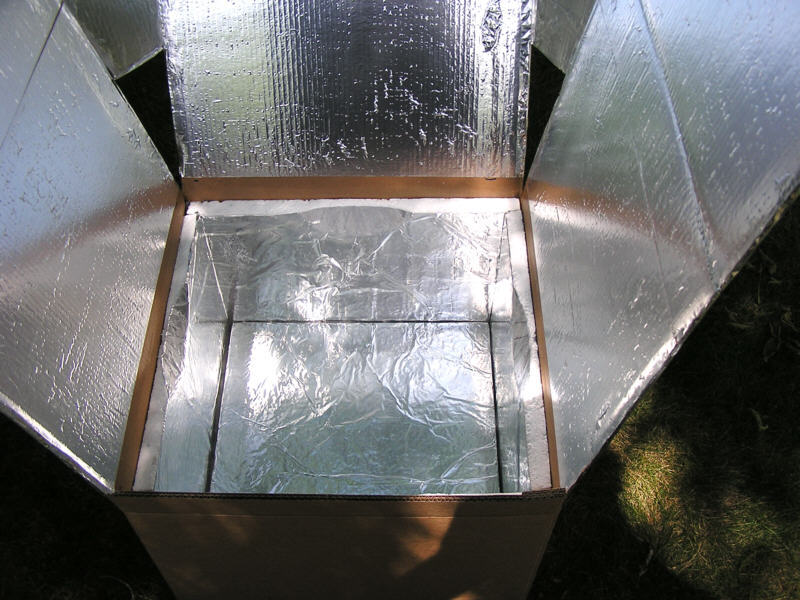
The following things were changed to increase the performance of the aluminum
foil oven:
The top flaps were left on and covered with foil ( Same surface area as the
reflector using flashing - 18" x 24" vs. 18" x 15")
The reflector angle was increased from 15 to 20 degrees from vertical to try
capturing more sunlight.
Styrofoam insulation on bottom and sides of box to replace the blanket.
Aluminum foil coating on the inside of the box to reflect back heat.
White glue was used this time instead of contact adhesive to attach the foil.
Unlike the tacky contact adhesive, it left a number of bubbles after it dried.
If I had poked holes in the foil and pressed them out as the glue dried, the
results might have been better.


July 12, 2007 - Sunny day with many clouds, breezy
Tested with no cover over metal bushel basket, 10 lbs. of pea gravel w/
12" black metal disk on top of gravel
Time - 1:50 pm, maximum temp. of 192 F at surface of 12" metal disk (After about
15 min.)
Test with glass cover over basket
Time - 3:15 pm, maximum temp. of 292 F at surface of 12" metal disk
July 13, 2007 - sunny day with light clouds, breezy
glass cover, pea gravel covered by 12" aluminum disk
10:00 am 75 F (Ambient)
10:05 am 192 F
11:33 am - Highest temp. 305 F
July 15, 2007 - sunny day with light clouds, breezy
glass cover, pea gravel covered by 12" aluminum disk.
Pre-heated oven
10:30 am 80 F (Ambient)
10:35 am 189 F
10:40 am 218 F
10:50 am 235 F
11:00 am 257 F
11:10 am 268 F
11:20 am 274 F
Water heating test
Aluminum pot with one quart tap water, covered by 12" aluminum disk,
T.C. temp. probe on bottom inside of pot.
11:23 am 73 F (Starting water temp.)
11:25 am 76 F
11:35 am 100 F
11:45 am 116 F
11:55 am 132 F
12:05 pm 144 F
12:15 pm 153 F
12:25 pm 162 F
12:35 pm 171 F
12:45 pm 179 F
1:00 pm 188 F
Test to 80 degrees C (176 F) to simulate a water pasteurization situation
took about 80 minutes.
Final Thoughts
The tests were run under less-than-ideal conditions (Poor insulation and/or
partly cloudy days in a northern area) to simulate possible real world
situations. The last tests used better insulation and a larger reflector surface
area. Maximizing the temp. an oven can reach may be a good relative indicator of
efficiency, but this design seems to have a limit just over 300 F.( 260 F is
achieved easily, but 290 F takes large amounts of energy supplied continuously).
A small cloud can cause a rapid drop when the oven temp. is close to 300 F.
Frequently adjusting the angles becomes important for maximum oven temp.
Supplying enough energy to overcome the load of the thermal mass of the food
(Or water) being heated to get it above 130 - 140 F quickly may be a better
goal. A cigarette burns in excess of 1000 F but has no real heating capacity. I
didn't use much gravel in the oven for the tests. There is plenty of room for a
lot more. Putting a large amount of thermal mass inside and pre-heating the oven
could help the process. I believe that it's important to get food out of the
range where bacteria can grow, especially if meat or dairy is involved, rather
than trying to kill the bacteria you started with plus more that you've grown.
The larger reflector area on this last design captures more sunlight and also
gives a more rapid recovery after clouds pass over. The box I used only had one
inch of side clearance to the basket, a larger box would have allowed more side
insulation.
This project is a variation of an insulated box design, which has been around
for a long time. Starting with a design that works gives a reference for making
modifications and improvements. It was easier for me to find a round container
to use for the inner box than the usual square or rectangular kind. The
reflector panels could be hinged or removable, for storage, or the angle made
adjustable to control the temp. This oven has a lot of space inside and could be
used for cooking or water pasteurization, using dark covered pots or jars.
With a screen over the top to keep out insects and the top partially covered,
this type of oven could also be used for drying food. Food could be placed on
racks or hung from a frame.