75th Year
Since October 7, 1952
The WITN-TV Story
How Channel 7 Started
|
This is a true story of some of the trials and tribulations of the
1955 beginning of WITN, Channel 7, Washington, NC. At the time, the only
station in Eastern North Carolina was WNCT-TV. Most of the story is on the
WITN history page at https://www.witn.com/content/news/witn-history-a-look-at-how-we-began-in-1955-27442154.html
but WITN redesigned their web page in 2016 and changed the history page URL
along with many other pages. You may
have to copy and paste the link to your brower. This link may or may
not work . It has history about WITN with my story at the end. Their
new web site is not near as good as the old one and very hard to
navigate. I've never been able to find a link on their new web site to
the history of WITN since the change in 2016. Found the link above by
using search pages. How
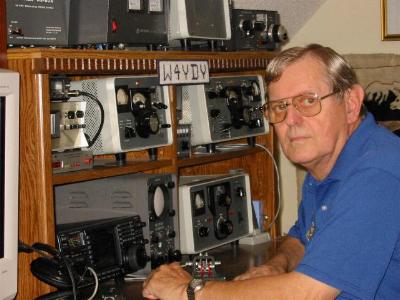
WITN-TV went on the air in 1955 by W4YDY Chapter 1
Since the studio was not ready for
equipment the first week, Harvey and I went to the Dr. Pepper plant warehouse
owned by Roberson Beverages. W. R. Roberson, Jr., was majority owner and
manager of WITN. The new GE studio equipment was stored among the stacks of
Dr. Pepper, orange, grape and other flavors of soft drinks. Harvey and I
unpacked the 2 studio cameras and assembled them on the tripods. When we
finished all we could do there, the studio was finished enough to take them
from Washington to Chocowinity. We put them in the back of Harvey’s pickup
and he drove the three miles to the studio while I sat on one of the tripods
under a camera and held the other one steady. We had a lot of folks watching
us going slowly down US-17 as that was a rare sight seeing the big TV cameras
going down the highway. I fired up the cameras for the first time a few days
later and got them set up ready for the WITN live shows. I continued working
at the studio installing the control room equipment until September 15. On September 14, I worked my last
day at WNCT. Lou told me that we were going to Winston Salem to get the old
WSJS-TV transmitter on Thursday September 15 and would leave after working
most of the day at the studio. WITN had bought the old GE Channel 12 WSJS-TV
(now WXII-TV) transmitter located on US-70 between Winston Salem and
Greensboro. WSJS had recently installed a new transmitter and tower on
Sauratown Mountain. Lou Hiland, Ed Piligard and I got
to Winston Salem about 11 PM on Thursday night with me driving a green Ford
station wagon with WITN lettering on the doors. I was surprised when I saw
the WSJS engineer waiting for us. It was Beacham Leonard, W4RXG, who had
known me all my life. He and my mother grew up next door to each other in
Nash County. I had talked to Beacham a few times on 75 meter AM. We all started to work removing the
wiring harness, dissembling the transmitter and get it ready to load in a
truck. We finished about 8 AM on Friday morning and called several trucking
companies. They had nothing available that day and we would have to wait
until Saturday to load it and take it back to Grifton. Lou, Ed and I got a
motel room and got some sleep during the day. As a side note, on Friday, Lou, Ed and I drove up to the new WXII-TV transmitter site on top of Sauratown Mountain in Stokes County North of Winston Salem. It was late in the day when we went there and the sun was going down when we left. After looking over their new facility, we headed back to Winston Salem to the motel. At the bottom of the mountain, a fellow standing beside his car that was in the ditch, waved us down. I was driving and Ed was in the front seat with me. Lou was sitting behind Ed. Lou rolled down his window and the man stuck his head in the window and asked us to help get his car out of the ditch. You could tell from his manner and speech that he had probably been partaking of the local "white lightning" that the county was known for. Lou told him we couldn’t help but we would call for a wrecker for him. He then pulled a big switchblade knife and quickly put it up to Lou’s throat. It had about a 6 inch blade. He said we were going to help or he would cut Lou’s throat. Lou talked to him a couple of minutes and then the fellow looked over at me. I couldn’t drive off because he had his head and arms in the car window and the knife against Lou’s throat. When he looked over at me, he said. "You’re the driver, what are you going to do, help or not?" At first I didn’t know what to say, but then I said, "Okay, we will help you. Move so I can park the car in front of yours." When he backed out, I put the pedal on the floorboard and left as fast as that station wagon would go. We didn’t know if he had a gun, but we didn’t stick around long enough to find out. Lou and Ed said they couldn’t figure out what to do to get the man to get out of the way, but it came to me that he might back off it I told him that we would help and needed to park the car. I haven’t stop to help anyone at night since then! Chapter 2 The next morning on Saturday, we
went back to the old WXII-TV transmitter site and loaded the transmitter on
the truck. We arrived back in Washington that afternoon and I picked up my
car at Harvey’s house and headed to Grifton. I picked up a sandwich at a
service station in Chocowinity (no such thing as Hardee’s back then) to eat
along the way as it was close to 6 PM. When I got to Grifton, the truck from
Winston-Salem had arrived and was being unloaded. Max Jordan, from Vanceboro,
had just started with the station. Ed, Max and I were the transmitter staff.
A GE engineer was there for assistance with the installation. Less than an hour later, a truck
arrived from Los Angles. It had the used GE TV transmitter 20 KW amplifiers
that came from KABC-TV, Channel 7. The equipment was unloaded and we started
connecting the wiring harness to the transmitter. The harness was in trenches
under the transmitter. We all worked until about 11 PM. We were scheduled to
go on the air on September 26, just eight days away. It was going to be 16
hour days to get it done. The antenna crew had not completed the tower
installation and had just lifted the antenna to the top of the tower. The 4½
ton gin pole was still at the top with an extra set of guy wires for extra
safety. I went to my home in Aurora and
arrived about 12 Midnight. I had to get my suitcase and other items to move
to a room in Grifton since I was going to be assigned to the transmitter
facility. I had planned to go back Sunday morning. BUT, guess what! Hurricane
Ione paid a visit and all day Sunday and early Monday it came through the
area. I figured that I couldn’t get to Grifton on Sunday, but I also woke up
that morning with food poisoning. That sandwich that I picked up at the
Chocowinity service station was the problem. I was okay Monday morning and after
the hurricane passed I headed to Grifton and arrived about the middle of the
day. When I arrived at the transmitter site, there were several men standing
in front of the building about 300 feet away. That was as close as anyone
could get. The building looked like it was in the middle of a lake with about
2 feet of water on the floor and the entire transmitter wiring harness in the
trench that we had installed Saturday night under the transmitter was under water.
Hurricane Ione had brought 10 to 15 inches of rain to the Grifton area. The
tower crew supervisor said he sat in his truck during the hurricane and
watched the tower to see if it would fall. He said with the 90 MPH wind
gusts, the tower looked like a snake wiggling up and down. He thought sure it
would fall with that 4½ ton gin pole still at the top of the tower. He said
the only reason it didn’t fall was because of the extra set of guy wires on
the gin pole. On Tuesday morning, the water had gone down and we were able to get back into the building. First we had to bail water out of the wiring trenches under the transmitter and then big floor fans were brought in to blow in the cabinets and trenches to dry the wiring and transmitter. We also started installing the associated equipment and the tower crew was finishing up the tower and painting it. A couple of days later, I was
sitting on a short stool working in the back of a transmitter cabinet and all
of a sudden, there was a big bang over my head and the roof and building
shook. We ran outside to see what had happened and if someone had fallen off
the tower. A tower crewman had dropped a gallon of unopened white paint from
about 200 feet above the building and it hit the roof on the side of the can.
We went on top of the building to check for damage. You couldn’t tell which
was the top or bottom because it had blown out both ends of the can and the
flatten can looked like a car had run over it. White paint had splattered
about 20 feet on both sides of the can. It’s a good thing the building had a
concrete roof or someone inside could have been hurt. Me! One of the pieces of equipment
installed was a microwave that carried the local programs from the studio to
the transmitter site. To save network delivery charges, management had the
telephone company send the NBC feed directly to the transmitter site since it
took one less microwave hop and it was cheaper. The transmitter engineer on
duty would follow the same program schedule and switch between the studio and
NBC. He had to monitor the network and cut back for local programs and
commercials. The problem was when the local microwave was installed we could
not get a signal from Chocowinity. Chapter 3 On Monday,
September 26, WITN was supposed to go on the air and broadcast the first
World Series broadcast in color from NBC starting Wednesday. We had the
wiring mostly completed, but still had not applied power to the transmitter.
We were giving it as much time as possible to dry from the flood a week
earlier. Finally on Monday, the GE Engineer applied power to the transmitter
and the fans came on and the tubes were glowing. Then he started making
measurements and adjustments to retune the transmitters to Channel 7. It had
to be moved down from Channel 12, the Winston Salem channel. The amplifiers
were just a touchup since they have been used on Channel 7 in Los Angles.
After running a few hours, he tried to put the visual transmitter on the air.
But there were problems and it did not work. Troubleshooting began that
lasted until late the next day.
On
Tuesday, we had visitors from the competing TV station to see how we were
doing. We had already missed the Monday sign on and the World Series was
closing in on us. Everyone was still working on getting the visual on the
air. The GE Engineer said the aural transmitter would be no problem. Late on
Tuesday afternoon, we were told that NBC had been told that we would not be
able to get on the air in time for the World Series. We were told that if we
did not get on the air by midnight, that the other station would get the
Series because it had offered to run the World Series free of charge. Bill
Roberson, manager of the station, and a couple of other station executives
were at the transmitter site with us anxiously waiting to see if we could get
on the air by midnight. Finally, the GE Engineer got the visual on the air
several minutes after 11 PM. He said the aural would be no problem. He said
NBC just said we had to be able to get the transmitter on the air by
midnight. Since we only had a picture from NBC via the telephone company
microwave and not the studio, we used the network and had it turned to black.
We needed a picture so about 11:30 PM, I was told to put the NBC picture on
the air. I faded in the video of Steve Allen Show (later it was the Parr,
Carson and Leno shows). Someone said we needed a signal report from the
outside. I made an offer and called my Dad, (Bill) W. W. Langley, about 11:40
PM in Aurora. He was awakened and I told him to turn on the TV and tune to
Channel 7. He reported that it was a very clear picture of someone talking
(Steve Allen) but it did not have any sound. I told him that we didn’t have
sound but would get it on tomorrow morning before the World Series started.
NBC was notified that we had a picture on the air. They said that we could
carry the World Series starting at 11:30 AM the next day on Wednesday,
September 28. Chapter 4 Wednesday morning, the GE engineer
started working to get the aural transmitter that we got from WSJS on the air
so we could sign on at 11:30. BUT the aural transmitter did not want to
cooperate. It would go on the air but drop out a few seconds later. And while
this was going on, we were working to get a feed from the studio but had
nothing but noise. To have local announcements, we at
least needed audio. The transmitter control console had an audio input for a
microphone. The building also had living quarters with a kitchen, bath and
bedroom. An announcer, Carl Caudill, was sent over to make station breaks
during the baseball game. The microphone with a long cable was taken to the
back bedroom (less noise there) along with a 17-inch B&W home TV set, our
only off the air monitor! Since we had no furniture in the bedroom, Carl and
I set up couple of metal folding chairs facing each other. The TV set was
placed on one chair in front of the announcer. Carl and I had to coordinate
when he was suppose to talk after we got on the air since we could not see
each other or had any type of communications. I was operating the console and
I told Carl when he saw the picture go to black when there was a local cut,
he would have about 2 seconds to turn the audio down on the TV and then I
would turn on his mike. I guess I was the first director at WITN although I
didn’t sign up for that job! We were scheduled to go on the air about a
minute before going to the network at 11:30 so Carl could make a sign on
announcement. As 11:30 approached, the visual
transmitter was put on the air about 11 AM with the picture from NBC set to
black. At 11:30, the World Series pre-game show, in color for the first time,
started and the aural transmitter still would not stay on the air. Still not
on the air, the minutes were going by fast as we watched the pre-game show
and at 11:45, the GE Engineer yelled that the aural transmitter was up and
running so we could start the World Series. I switched on the video and audio
and the first program came up in color with the United States flag waving at
the ballpark filling the screen. Then the National Anthem started for the
World Series. WITN signed on with the National Anthem and the color US flag
by a lucky break because we had no way to have local video at that time. It
was almost like a Hollywood script! There probably were not a dozen color TV
sets in Eastern NC and we didn’t have one at the transmitter site. I could
monitor the color burst on the oscilloscope to confirm that we were
transmitting in color. There were 10 to 15 people at the
transmitter site watching the events to see if and when we were going to get
on the air. They included Bill Roberson, manager of the station, and some
other officers and employees of the station. I remember Carl Caudill standing
near me so we could coordinate the first station break at 12 Noon. Everyone
was very pleased when the National Anthem and flag came up for sign on. At the first break at 12 Noon, I
faded the NBC video and audio and switched the audio to the mike and turned
it up about 2 seconds later. Carl made a sign-on announcement and informed
the public that we would only have audio station breaks with a black picture.
This was the first local audio and it was 15 minutes after we were on the
air. There would be no audio for much of the breaks after a short
announcement and station identification. At the end of the ball game, Carl
announced that we were signing off until the second game started on Thursday
at 11:30 AM since we had no microwave studio signal and no local picture. Then we went back to work checking
out the equipment and working on the studio to transmitter microwave. About
half way through the first ball game, for the first time, we saw a faint test
pattern coming though from the studio. We had communications with the control
room with a two-way radio. After the ball game, the microwave signal from the
studio was getting better. Chapter 5 The next day, we went on the air
about 11 AM with the audio and video from NBC turned down until 11:30. About
11:29, I turned the mike on and from our "bedroom studio", Carl
Caudill signed on and made the same announcements as the first day. After
World Series game two, Carl signed off and announced that we would return to
the air at 6 PM with news and entertainment and the NBC Thursday night
lineup. Still not a good picture from Chocowinity but it was getting better.
Just before 6 PM, we had the transmitter back on the air with a slightly
snowy test pattern from the studio. About the middle of the day on Thursday, FCC Inspector Bennett from the Norfolk office arrived at the site unannounced. He had ‘heard’ that we might not be in compliance with FCC regulations and he wanted to inspect the facility. He was there while we had the second World Series game on the air and he took a lot of notes walking all around the facility. Everyone was worried that he would tell us to shut down and we would not be able to carry the World Series. There was still a station ready to carry it if we couldn’t. After the inspection, he wrote out ten citations that included no frequency monitor, no audio level monitor, no test oscilloscope, only a volt-ohmmeter for test equipment, no permission to run low power on the aural transmitter, inadequate spare tube supply and parts and other problems. The monitors did not arrive at the site until about a week later. It was on back order. Mr. Bennett said we could stay on the air but we had to fix and reply to every citation. He did not remember me, but he gave me the Morse code test and exams for my first Amateur Radio license, W4YDY, three years earlier in Norfolk when I was still in high school. He was a very nice man. I think he took in consideration that we had many problems due to the Hurricane a week earlier. At 6 PM on Thursday, the first
local program and local video started with the 15 minute news block followed
by the "Camel News Caravan" a 15-minute newscast hosted on-camera
by John Cameron Swayze. Later during the NBC evening lineup, the signal from
the studio got weaker and weaker. By 10 PM, it was gone. I informed the
studio that I was not getting a signal and they told me to make announcements
on the NBC station breaks and sign off after the NBC shows finished at 11 PM.
I hooked up the microphone at the transmitter console, wrote a very short
script and made the station breaks announcing there were technical
difficulties. I signed off at 11 PM and announced that we would be back on
Friday at 11:30 AM for World Series game three. When we went back on the air on
Friday, the microwave was better but still some noise. For the next week, the
microwave would fade out so it was not usable after about 10 PM. So Max
Jordan or I just made the announcements and signed off at 11 PM. A new
microwave system was installed and that fixed the problem after the first two
weeks on the air. A Motorola one watt microwave operating at about 7000 MHz
replaced the GE 10 watt unit operating at 2000 MHz. We rarely had trouble
with the Motorola unit.. So when WITN signed on, the first
1½ days only had NBC network pictures and all local audio originated from the
transmitter site by Carl Cardill with a black screen. It was 6 PM on
September 29, 1955 that the first local program came from the studio in
Chocowinity. The studio was not flooded, only the transmitter site. The
problem with local programming was the faulty microwave system between the
Chocowinity studio and Grifton transmitter. After the World Series and getting
a good picture from the studio, we would sign on at 2 PM with some NBC
programming. That included the Howdy Doody Show, the first TV series to be
aired in color starting in 1955. It was the first NBC series to air five days
per week and first children's series to be broadcast nationwide. Max Jordan
and I would work the shift work and Supervisor Ed Piligard would fill in when
we needed vacation time. Max and I would normally get off duty after the
local news and signoff at 11:15. One night a week, each had to stay
over until 4 AM, Max on Tuesday night and Thursday night was my turn, doing
maintenance on the equipment that included checking tubes when we could
borrow the tube checker from the studio. The station had only one oscilloscope
that was kept at the studio. We borrowed it from time to time and to help
out, Ed brought his Heathkit oscilloscope from home at other times. We also
had to clean the equipment cabinets inside and out, mop the floors and clean
the bathroom! Ed would come in for a few hours sometime to help with
maintenance on the equipment when two persons were required. Sometimes field
mice (we were in the middle of farm fields) would come in the building and
get inside the transmitters. When they got on the 10,000 volts, it sounded
like a 22 rifle going off and the transmitter would shut down. We would hit
the button and it would come back on. After signoff, then one would have to
go in the back of the cabinet and scrap the mouse or what was left of him off
the walls! It looked like it was in hundreds of pieces. The transmitter site was not air
conditioned. During the summer it was very hot with the temperature in the
nineties at the console. Since I was there by myself most of the time, I
would put on my bathing suit and tried to stay cool with a big fan blowing
nearby. We couldn’t leave the console long because we had to switch between
NBC and the studio and also monitor the equipment. Thank goodness that the
bathroom had a shower. After signoff, I would take a shower before going
home. It felt like a hot shower in the transmitter room. Chapter 6 In early 1956, Mr. Roberson gave me
permission to put a Amateur Radio station next to the control console. He
signed the FCC application and I sent it in. I was assigned a second station
call sign, K4IWJ. I set up a Hallicrafters SX-71 receiver and a Heathkit
DX-100 150 watt AM transmitter on the right side of the console. What to use for an antenna? I
decided on one for 75 and 10 meters connected to the same transmission line.
I made a dipole and fed it with 200 feet of RG58 coax. It was cheap and the
loss was not too great for my purpose. Now how to get it up the tower. I got an scrape piece of high
voltage wire with a slick coating about 4 feet long. I tied it to one end of
the 75 meter antenna and also tied a ball of string to it. I climbed up to
the first guy wire on the tower that was at 300 feet. The high voltage wire
was looped around the guy wire and the ball of string was dropped to the
ground. It unwound okay and did not tangle. I then climbed down the tower and
tied off the other end of the dipole 120 feet lower because that was how long
the antenna was. Back on the ground, the string was pulled and the dipole
with the loop on the end slid easily down the guy wire. Then back up the
tower to lower the other end to about 120 feet. Back on the ground, pulled on
the string again and this time when it stopped, the dipole was parallel to
the ground. I had a 75 meter antenna up 1/2 wavelength! When it came time to
remove it, I climbed to the 120 foot level. When it was untied if from the
tower, it slid down the guy wire. With the antenna at 120 feet, I
thought I would get out great with it. And it did work very well. But when I
tried to talk to my friends in Eastern North Carolina on 75 meters, they
reported that it had the signal strength of a mobile but they could hear me
okay. When I talk to stations over 200 miles away, they said I was very
strong. One report about 300 miles away in Western North Carolina said he though
I was transmitting from next door! He said I was very strong. There was no problem on 75 meters
but I couldn’t use 10 meters when WITN was on the air because it caused faint
wiggle lines on the TV signal going to the TV transmitter. I contacted a
friend near New Bern and he said he cold see the wiggle lines. Not good! I
didn’t want TVI all over Eastern Carolina! No 10 meters when we were on the
air. Remember, back in those day, WITN was only on the air from about 2 PM
until after the 11 PM news. I was able to get on the ham radio
and monitor the TV at the same time. Naturally if something came up that
needed attention on the TV, the ham radio took a back seat. If for some
reason I lost the 2-way radio and telephone, I would still have the ham radio
for communications as long as we had electricity. Once that did happen. I
contacted someone on 75 meters to relay a message to the studio that we had
lost the telephone and I couldn’t raise them on the 2-way radio. Found out
that the problem was that their volume was turned down. The skip on 26 Mc was
distracting them in the control room. I needed to stay in touch. On December 6, 1956, I worked my
last day at WITN. On December 7, 1956, I started working for WRAL-TV in
Raleigh helping with the installation about a week before they went on the
air. On June 26, 2009, I watched the
final sign-off of analog Channel 7 with the announcer giving the standard
sign-off with the last part saying "This concludes operation of WITN
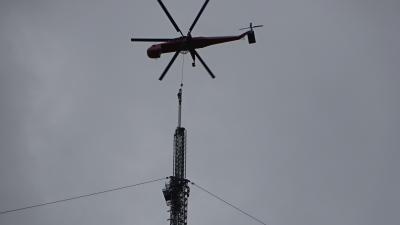
analog Channel On October 30, 2019, a crane
helicopter replaced the 4 1/2 ton antenna on top of the 2000 foot
tower. The Chief Engineer told me when it was going to happen so I went
out to see the antenna transfer. It was quite a sight. It didn't
take long. I took pictures and video. WITN has very interesting
raw video on YouTube at Still don’t understand why WITN does not use channel 7 on the air as part of their ID or on their web site. When they added another channel, they said to tune to 7.6, not Breaking News and Weather Authority. My remotes only have numbers that work! All other stations use their original channel numbers because that is still the channel you can select on your TV. - W4YDY
|