Pluto SDR 902 Linear Translator
Have been testing Remote SDR by F1ATB to control the ADALM Pluto Software Defined Radio (SDR) remotely. This setup uses a Raspberry Pi 5 computer to run control software to the USB-connected ADALM Pluto SDR and then enable remote Ethernet wired communications via a web browser on another PC. For background, please see previous posts on this topic (Post 1 and Post 2).
Ran into the problem of only having one radio - how do you test it and who do you talk to? To get around this, I put together a quick full-duplex linear translator (or repeater) on the 33 cm band using my second ADALM Pluto SDR. This uses GNU Radio Companion (GRC) running on a laptop PC with the Pluto being connected via USB.
The photo below shows the Remote SDR Pluto (#2) & Raspberry Pi 5 at the top of the screen and the second Pluto (#1) connected via USB to a laptop PC. The post-it note calls out each Pluto's transmit and receive frequencies. Both Pluto SDR have their mini-antennas attached to both TX and RX ports.
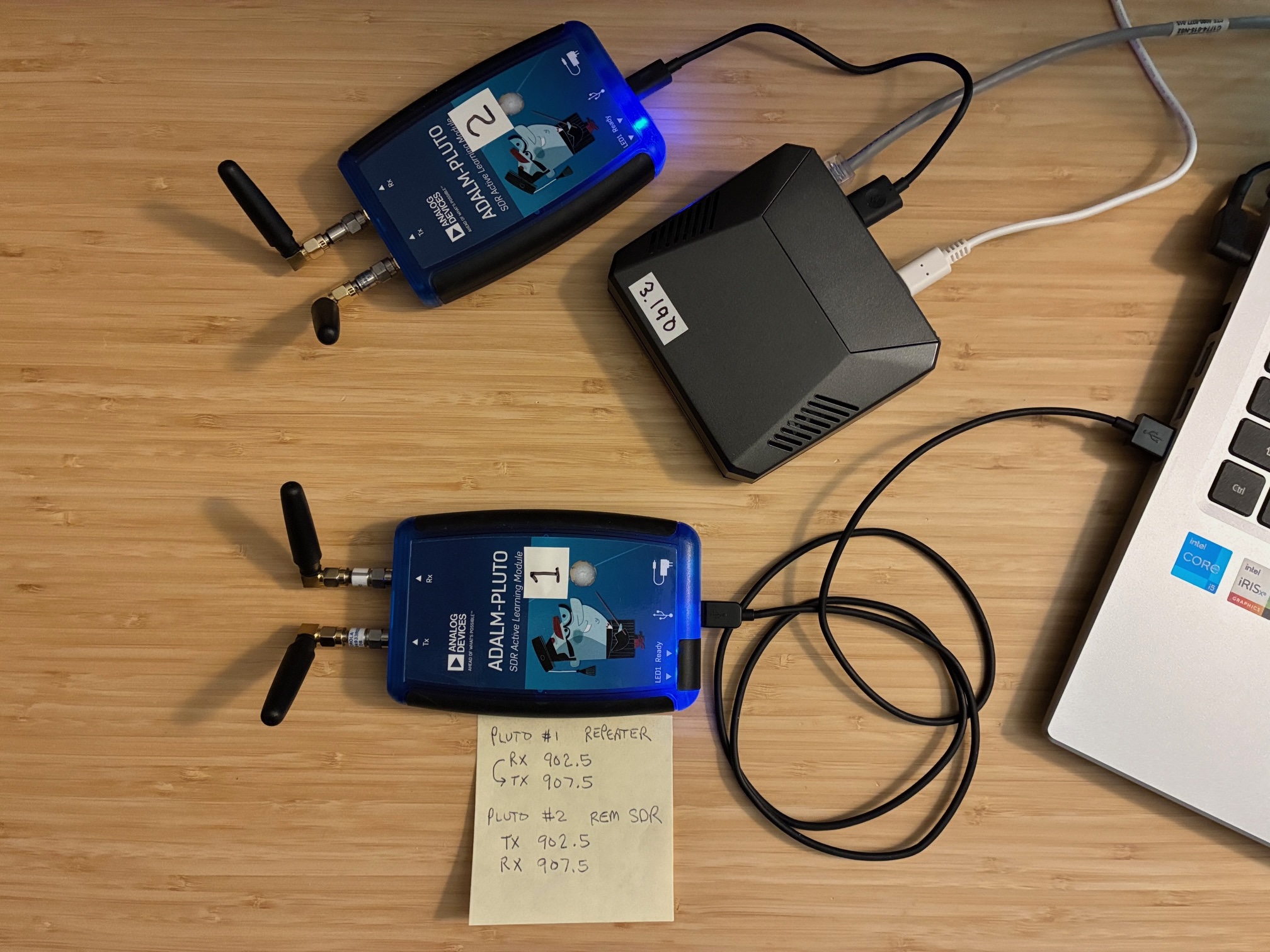
The purpose of this linear translator is to just loop back to the Remote SDR Pluto what ever is sent to the local repeater. The program to accomplish this is quite simple.
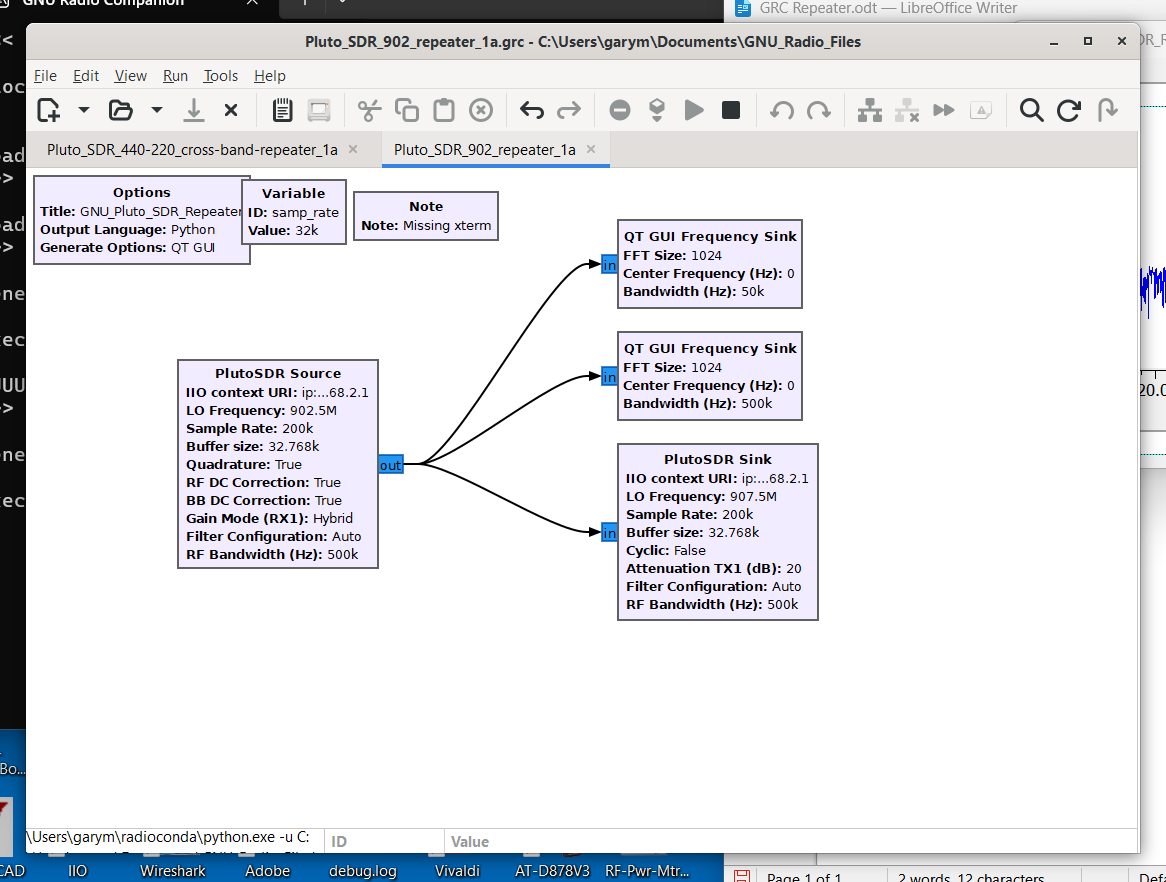
The left element (PlutoSDR Source) connects to the Pluto's receiver on 902.5 MHz and outputs a bit stream. That bit stream is fed into the lower right element (PlutoSDR Sink) which receives the data and sends it to the Pluto's transmitter on 907.5 MHz. The data is not decoded or otherwise processed, just data in to data out. Thus, this is a true linear translator and is not modulation limited (AM, FM, DMR, SSB, etc.). RF input yields RF output on another frequency.
Setting up Remote SDR for the corresponding RF frequencies (with Narrow FM mode selected), and plugging in a headset/microphone to the laptop, yields the ability to talk into the microphone and hear your voice come out of the headphones! It works!
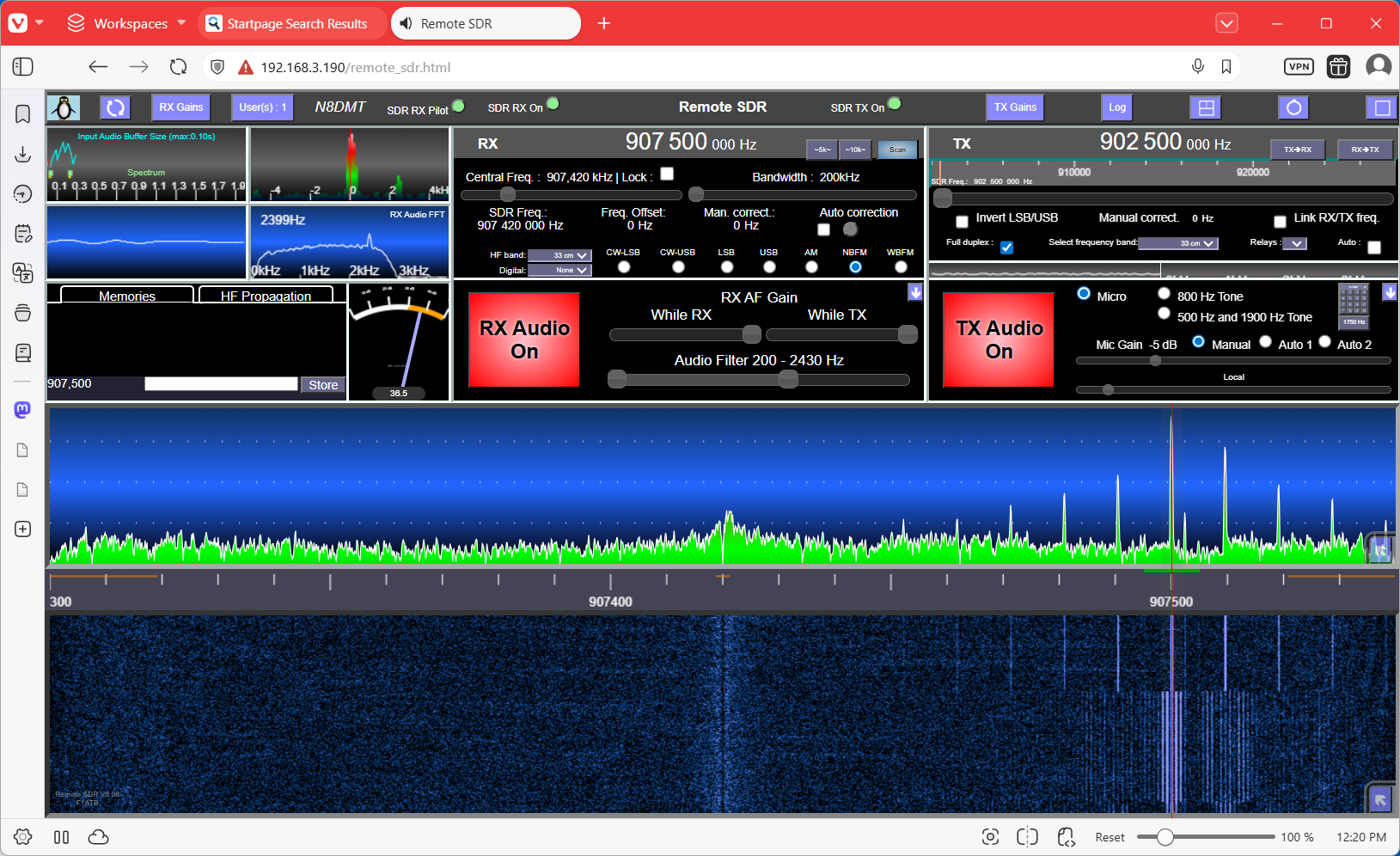
Achievement Unlocked #1 - The Pluto 902 Remote SDR transceiver works in full duplex!
Achievement Unlocked #2 - The GRC 33 cm "repeater" works, supporting further integration and test of the 902 MHz transceiver.
More fun ahead (now with remote control and full duplex)!
All author photos captured with an iPhone 16e.