RF Detectors: RF In yields DC Out
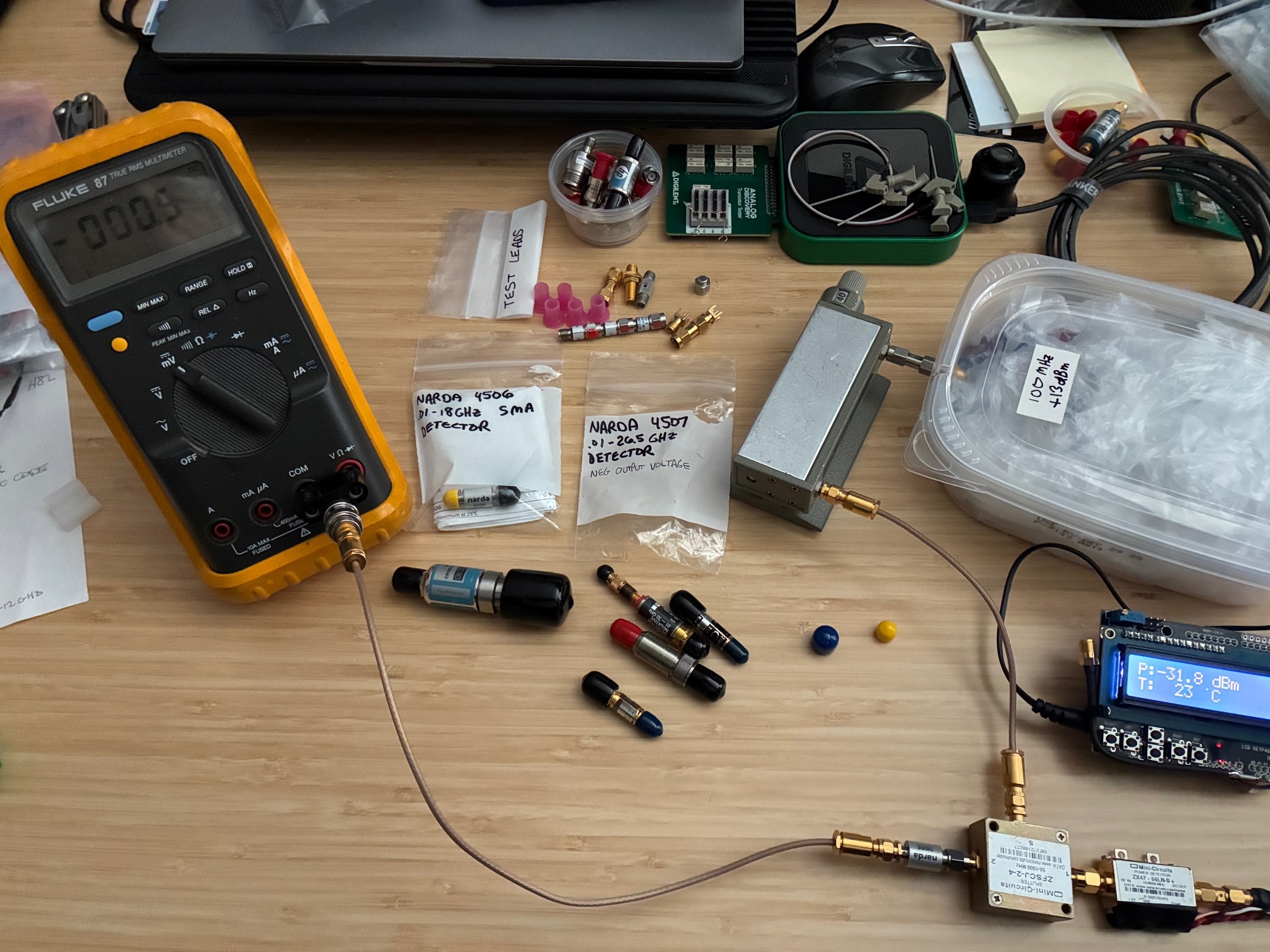
Had the small fleet of RF detectors out today and after measuring a trio with the Digilent Transistor Tester (in diode mode), decided to go ahead and test all of them for basic detection performance (RF level in to yield an output DC voltage). Performed this very quickly using a fixed frequency 100 MHz test oscillator, a 10 dB RF step attenuator, a splitter feeding off to a monitoring DIY RF power level meter and the detector being tested with its output connected to a digital multi meter. Note that this type of RF detector diode has been largely superseded by RF detector integrated circuits.
The decision to test at only a single frequency of 100 MHz greatly simplified the setup, but ultimately did not allow proper characterization of one or two of the detectors (which cover higher frequencies). You'll quickly see which of the detectors had super-low output at 100 MHz.
Here is the test setup:
Collected the test data (RF level / attenuator setting and output DC voltage) in a LibreOffice spreadsheet. Still getting up to speed on this tool having abandoned Microslop recently...
Here is the collected data for the seven detectors tested:

Note that two of the detectors have a positive output, rather than a negative output. A positive voltage output is an option for some RF detector models. The standard model provides a negative output voltage that grows more negative as the signal intensity increases.
Putting together a simple X-Y chart yields this perspective on their performance for each of the five input levels. (The absolute value of the output DC voltage was applied to simplify the plot creation.) The vertical scale is DC output voltage and the horizontal scale is input power in dBm.
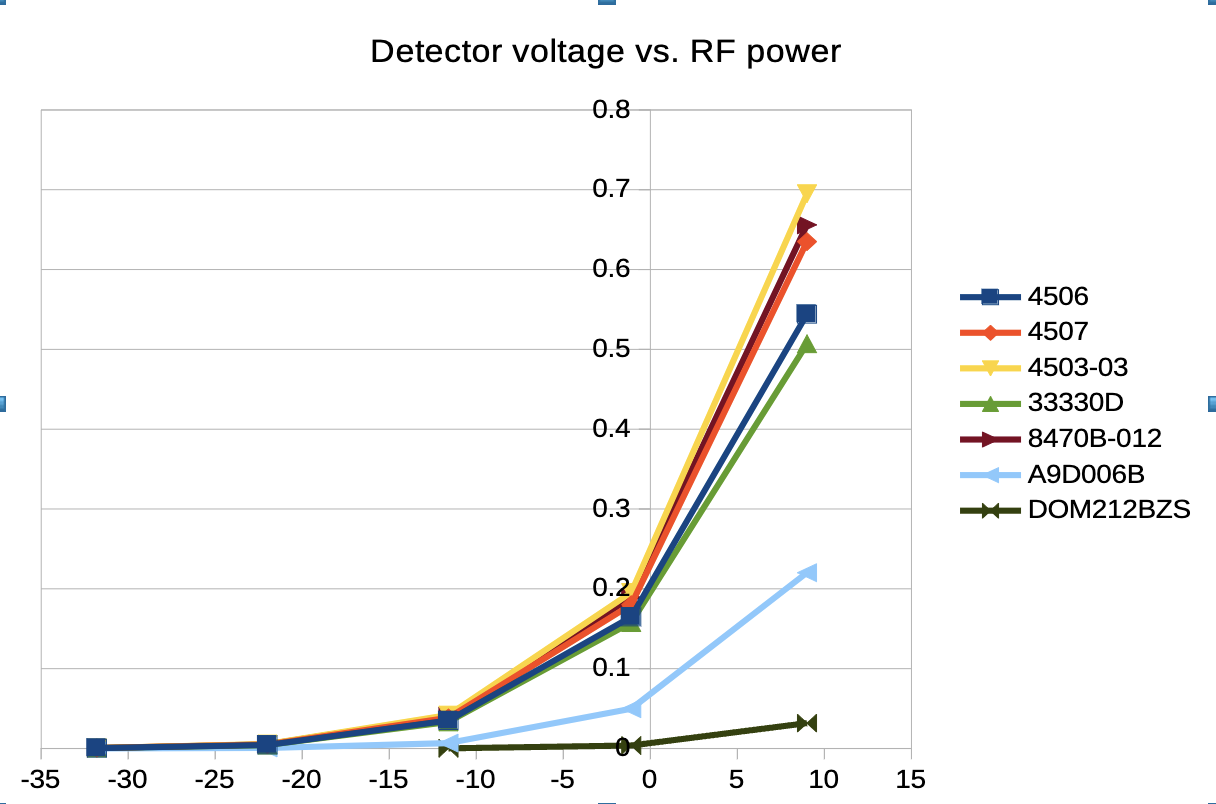
It should be noted that the last unit (AerTech DOM212BZS) is the detector designed to cover the 2-12 GHz band. I tested this yesterday at 2 GHz using the Pluto SDR as a test signal source, and it had plenty of output with even a modest 2 GHz input test signal. Both it and the unknown frequency range AerTech A9D006B are very old units, likely from the late 70's or early 80's. The AerTech A9D006B also had good output up at 2 GHz. Clearly being operated down at 100 MHz did not yield a fair test compared to the five broad frequency range detectors. I may retest in the future up at 2 GHz where all should be more closely equivalent to each other at that point. If it continues being very cold here in Chicagoland, that day may come sooner rather than later.
SUMMARY: Today's simple functional performance check is completed for the lab's RF detectors. All are working reasonably and are ready to return to modular RF components storage.
All author photos taken with an iPhone 16e.